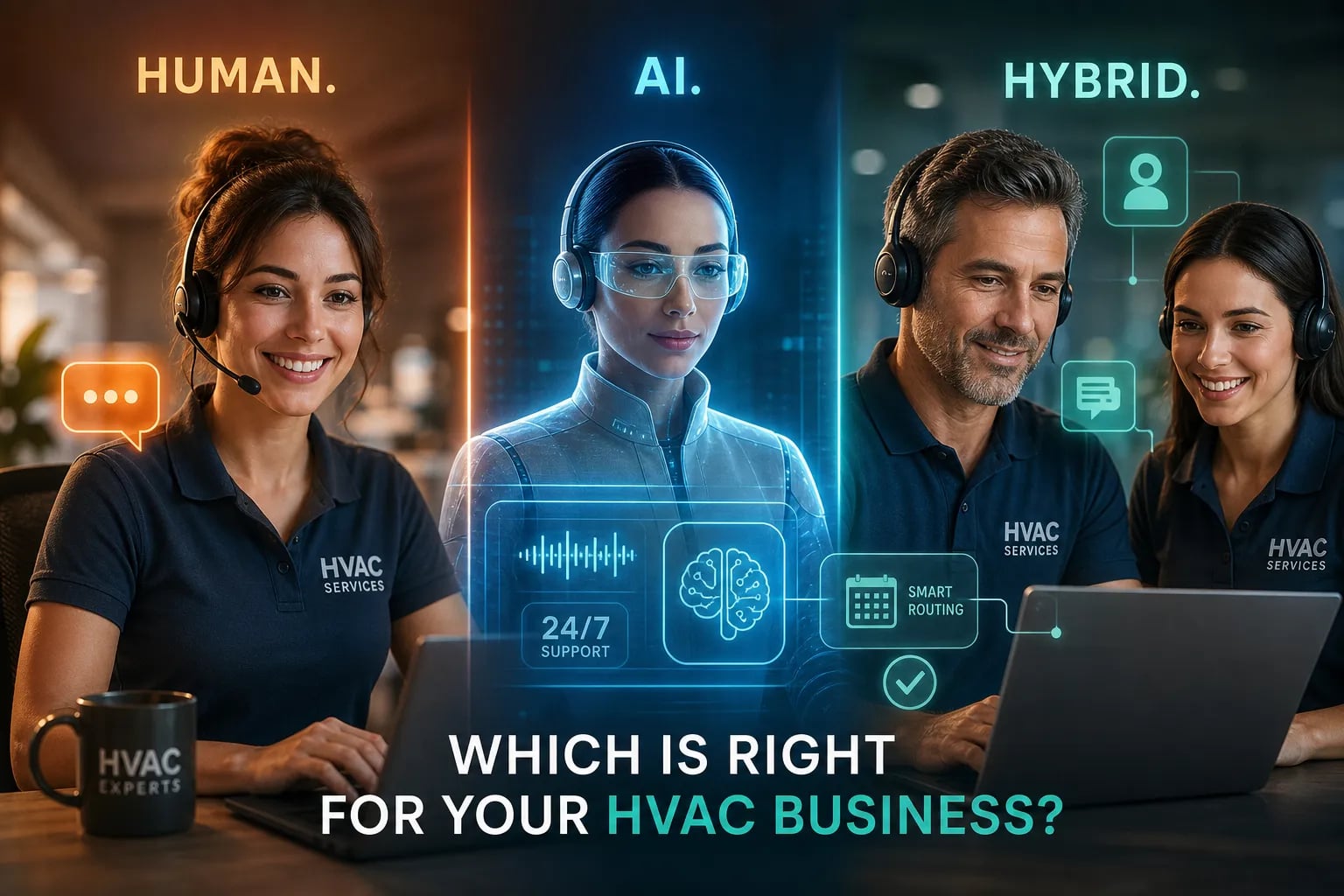
A virtual receptionist for HVAC can mean the difference between a booked job and a lost customer. Your phone is your revenue pipeline. Every ring that goes unanswered during a July heat spike or a January furnace failure is a potential booking that goes straight to your competitor. During peak season, when call volume can rise three to five times above baseline and your techs are already running full schedules, the gap between calls received and jobs actually booked gets expensive fast. Industry estimates put the average missed-call cost for HVAC companies between $180 and $1,200 per call, depending on job type and season.
The problem is that not every virtual receptionist option is built for how HVAC businesses actually operate. Some systems are designed for message-taking. Others are built for revenue capture, they answer, triage, book, and dispatch without dropping the ball when it matters most. AnswerCapture’s AI-powered call infrastructure was designed specifically around that gap: the space between demand that already exists and revenue that actually gets collected.
This article breaks down the three main models, human, AI, and hybrid, with real pricing, performance benchmarks, and integration requirements so you can pick the right fit and switch without losing a single booking in the process.
Why HVAC call handling is different from generic answering services
Most answering services were built for one thing: taking messages. They’re designed for offices that need a friendly voice to log a caller’s name and number before routing the request to someone who will follow up later. That workflow is completely misaligned with how HVAC calls actually arrive.
HVAC inbound calls cluster unpredictably, carry real urgency signals, and require immediate triage, not a callback queue. A caller reporting no heat in January or a gas smell at any time of year needs a different response than a caller booking a spring tune-up. A generic contractor answering service treats both calls identically, which means your emergency just got triaged the same way as a filter question.
The emergency vs. routine split every HVAC call carries
Every HVAC inbound call lands on one of two tracks: emergency dispatch or routine booking. An emergency (no cooling, no heat, gas smell, or carbon monoxide concern) needs immediate escalation to your on-call tech. A routine call needs an available slot in your schedule. A purpose-built HVAC call answering service separates these at the point of intake and acts accordingly. A generic service logs both the same way, and the emergency waits in a pile with everything else.
Seasonal spikes and what they expose in your call coverage
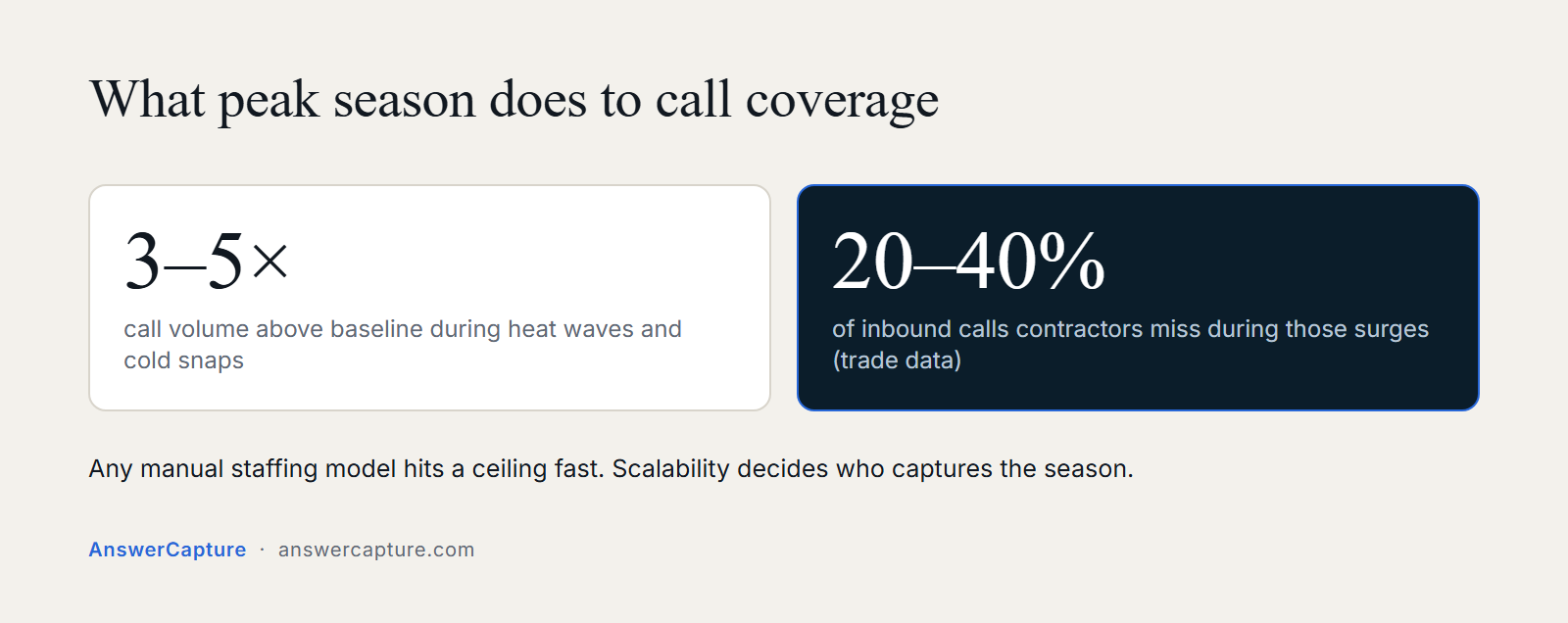
Peak HVAC season is the clearest stress test for any phone answering setup. Call volume can rise three to five times above baseline during heat waves and cold snaps. Trade data consistently shows contractors miss 20 to 40 percent of inbound calls during those surges. Any manual staffing model, whether in-house or through a live answering service, hits a ceiling fast. Scalability isn’t a nice-to-have feature for HVAC operators. It’s the feature that determines whether you capture the season or hand it to your competitors.
Virtual receptionist for HVAC: three models compared
HVAC contractors in 2026 have three real options: live human virtual receptionists, AI-based systems, and hybrid models that combine both. Each has a distinct operational profile, and the right choice depends on your call volume, hours, and whether you handle genuine emergency dispatch.
Live human virtual receptionists: strengths and limitations
Human remote receptionists handle empathy well and are capable of managing genuinely complex calls that require judgment. For HVAC businesses with lower call volumes and daytime-only coverage needs, a live service can work. The limitations show up fast under pressure. A human receptionist handles one call at a time, performance varies by agent, and costs spike hard when seasonal volume drives up billable minutes. A busy Monday morning in August is exactly when a human-only service starts missing calls.
AI virtual receptionist for HVAC, how it triages emergencies
An AI receptionist built for HVAC operates differently from a generic bot. It runs emergency triage scripting to catch phrases like “no heat” or “gas smell,” checks live calendar availability to book real slots, logs every interaction to your CRM, and routes urgent calls to your on-call tech immediately. AnswerCapture says its system was built on this model, developed by someone who ran an HVAC business and experienced the revenue cost of missed calls firsthand. That operational background shapes how the system handles a call, not just the marketing language around it.
Hybrid models: AI intake with human backup
Hybrid services run AI for first-touch intake and route escalations to a human when the call requires more judgment. Coverage is better than human-only, and the AI layer absorbs most of the volume without per-minute billing spikes. The trade-off is cost: hybrid plans are more expensive than pure AI, and the quality of human backup varies significantly by provider. If the human layer is offshore or undertrained on HVAC-specific triage, you’re paying more for a coverage gap you may not notice until a bad emergency call slips through.
What each model costs in 2026
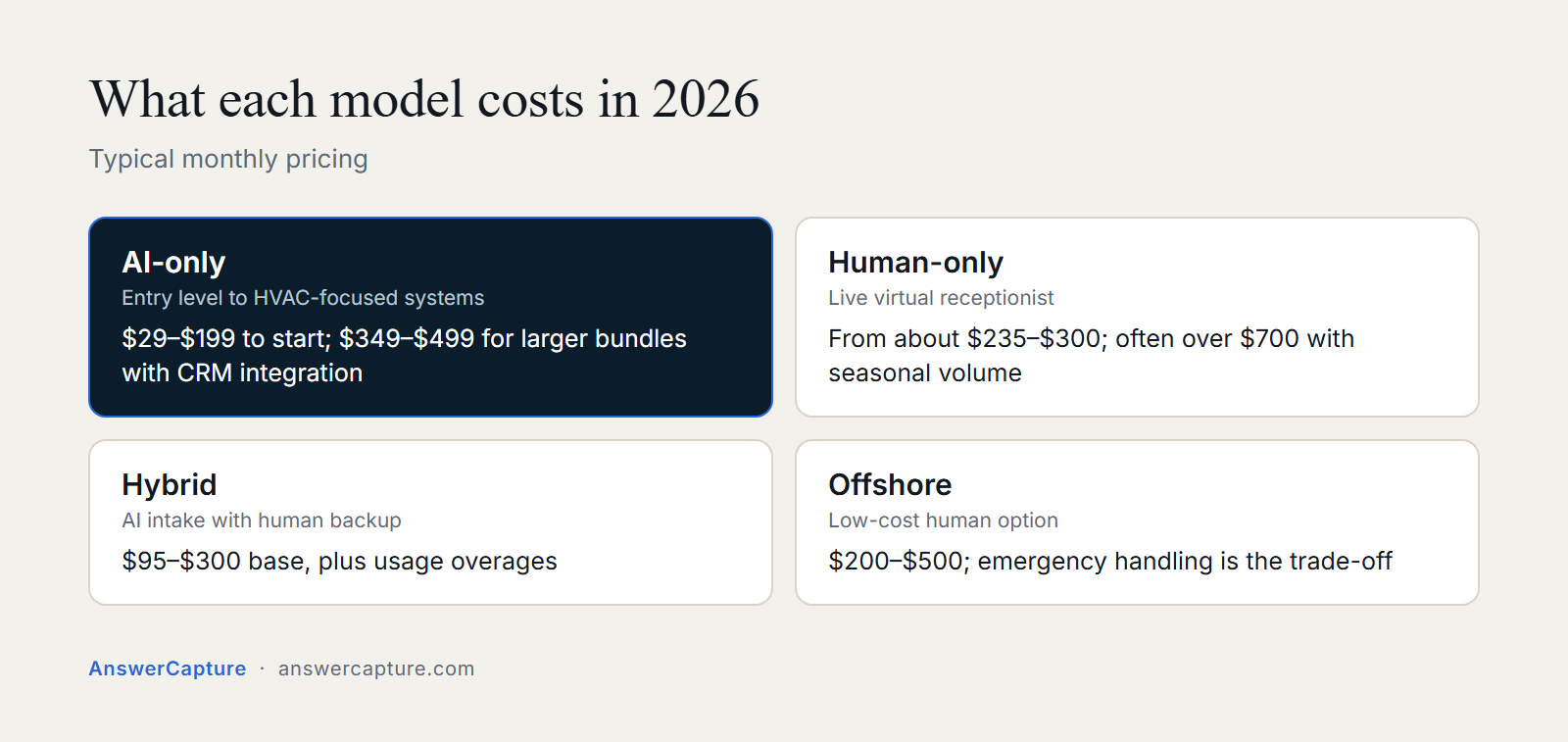
AI-only plans typically start at $29 to $199 per month at the entry level, with feature-rich HVAC-focused systems running $349 to $499 per month for larger minute bundles and full CRM integration. Human-only services generally start around $235 to $300 per month and commonly exceed $700 per month once seasonal call volume is factored in. Hybrid plans usually sit at $95 to $300 per month as a base, with usage overages on top.
Setup fees matter too. Lighter AI plans often carry no setup cost. More complete HVAC-specific AI infrastructure, the kind that includes implementation, CRM configuration, dispatch routing, and booking integration, may include a one-time setup investment in the $1,000 to $5,000 range. That’s a fundamentally different product than a $49/month bot that answers and logs a message.
The hidden cost that pricing tiers don’t show
Cost per booked job is the number that actually matters, not the monthly rate. A $99/month AI system that captures calls 24/7 and books appointments in real time produces a very different per-job cost than a $400/month live service that misses 30 percent of calls during your busiest week. Run the math against your actual call volume and your average job value, and the comparison becomes straightforward.
Offshore virtual receptionists: the low-cost trade-off
Offshore services typically run $200 to $500 per month and look attractive on a spreadsheet. For HVAC, the risk is real: emergency call handling requires dispatch language precision, urgency recognition, and local context that offshore agents consistently struggle with. The most common failure points are missed emergency keywords, slow or incorrect escalation to the on-call tech, and incomplete intake that sends a technician to a job without the information needed to do it. The cost savings disappear quickly when one missed emergency call costs you $1,200 in lost revenue and a customer who never calls back.
How the models stack up on real booking performance
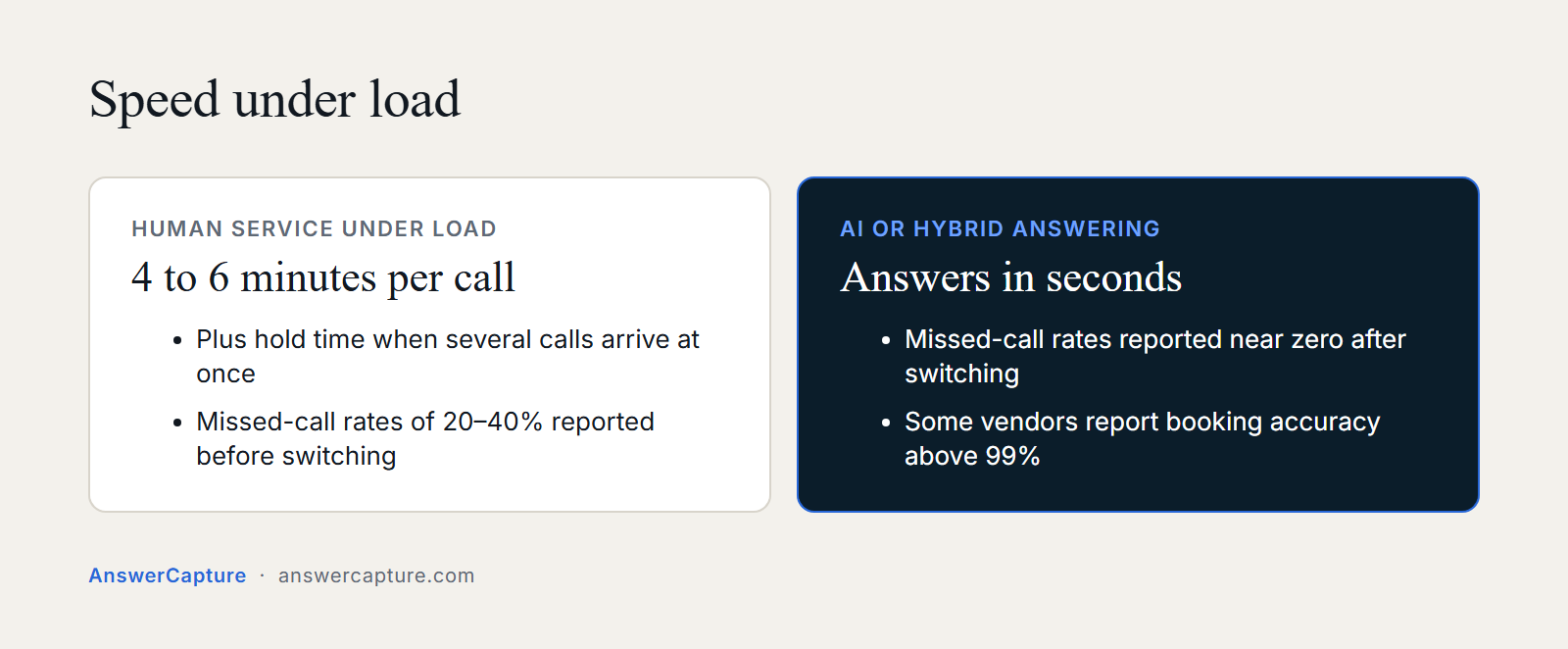
AI systems answer in seconds. Human services under load take four to six minutes per call on average, and that’s before accounting for hold time when multiple calls arrive simultaneously. Client data from operators who switched from human-only to AI or hybrid answering consistently shows missed-call rates dropping from the 20 to 40 percent range to near zero. That’s a structural change in how many jobs actually get into your schedule, not a marginal improvement.
Response time and call containment during high-volume periods
AI handles simultaneous calls without building a queue. A human service processes one call at a time, which means the second caller during a summer surge either waits or hangs up. Peak season is precisely when your coverage matters most, and it’s also when human-only systems are most likely to fail under the load. Hybrid systems absorb the volume through AI intake and escalate complex calls to humans, which is why they consistently outperform human-only models on scalability.
Booking accuracy and what happens when it fails
A booking error in HVAC is expensive. Wrong address, wrong service window, or a missed urgency flag means a wasted truck roll or a lost job. Structured AI booking workflows can achieve very high accuracy rates, some vendors report figures above 99 percent, because the system collects the same fields every time and writes directly into your scheduling platform without manual data entry. Human performance varies by agent and degrades under high call volume. For HVAC operators running tight schedules, booking accuracy isn’t a secondary metric. It’s the difference between a profitable day and a chaotic one.
Integrations that determine whether bookings actually stick
A virtual receptionist for HVAC that answers calls but can’t push a job into your field service management software creates more work than it saves. Before signing up for any HVAC answering service, confirm what it actually connects to and how. The integration method matters as much as whether the integration exists at all.
FSM software connections: native vs. workaround
Native integration with ServiceTitan, Housecall Pro, or Jobber means the system writes directly into the platform during the call. A Zapier or API workaround introduces middleware delay, and even a short lag can create double-bookings when two calls arrive close together. Several providers describe ServiceTitan or Housecall Pro integration in their marketing but rely on Zapier under the hood. Ask the provider directly whether the connection is native and whether it writes the job record in real time during the call, not after.
Calendar sync, CRM logging, and dispatch routing
Beyond FSM connections, three integration requirements are worth verifying before you go live. Live calendar availability sync ensures the system only offers open slots rather than overbooking your techs. CRM logging of every call gives you full visibility into customer interactions without manually reviewing recordings. Emergency dispatch routing means urgent calls reach your on-call tech by text or phone immediately, rather than sitting in an office inbox until someone checks it in the morning.
How to pick the right virtual receptionist for HVAC and switch without losing bookings
The decision comes down to three variables: your current call volume, whether you have meaningful after-hours demand, and whether you handle genuine emergency dispatch. High volume plus after-hours calls plus emergency dispatch needs point clearly toward AI or hybrid. Lower volume with daytime-only coverage and no emergency handling can work with a quality human service. For most growth-focused HVAC operators already spending on advertising and generating inbound demand, AI or hybrid delivers better ROI than human-only, because per-call cost goes down while coverage goes up.
Matching model to your HVAC operation’s actual call profile
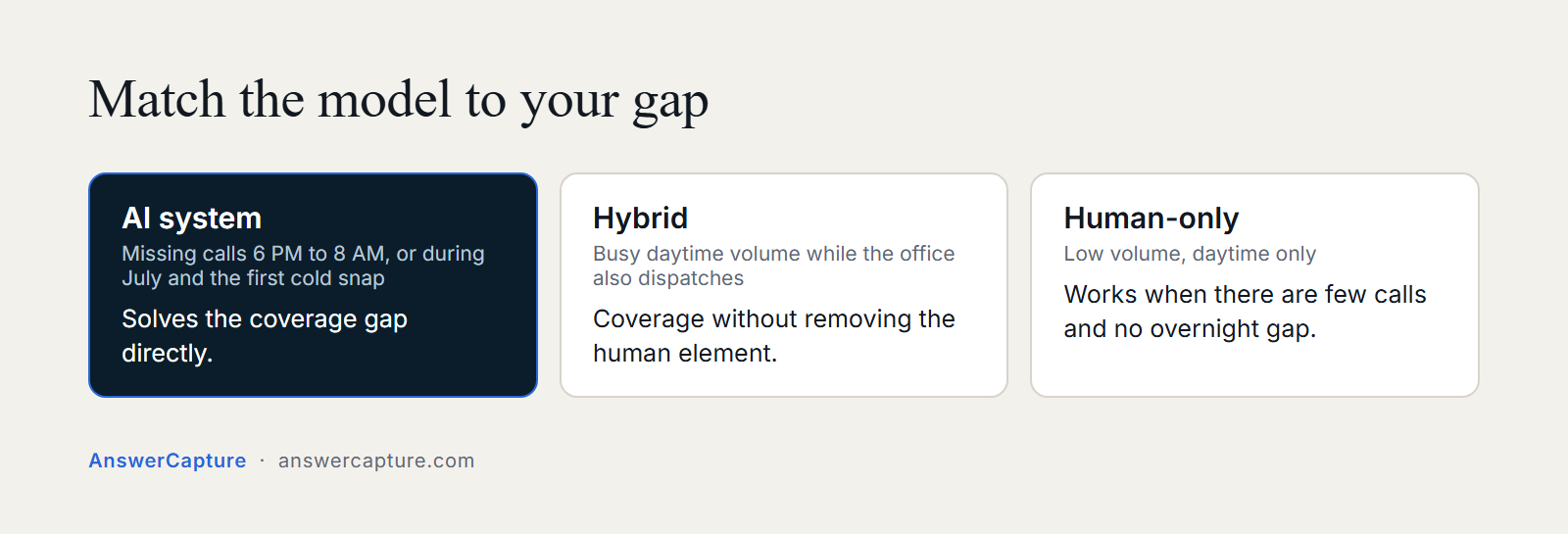
If you’re missing calls between 6 PM and 8 AM, or during the first two weeks of July and the first cold snap of winter, an AI system solves the problem directly. If your biggest gap is daytime call volume during a busy stretch when your office manager is also dispatching, a hybrid model buys you coverage without removing the human element entirely. The goal is matching the solution to the actual gap, not buying the most features or the cheapest monthly rate.
A short checklist for switching without a coverage gap
Before you change anything, document your current call routing so you have a clear picture of where calls go today. Run the new service in parallel with your existing setup for five to seven business days to verify it’s handling calls correctly before you cut over. Confirm FSM and CRM integration is fully functional and writing records in real time before going live. Then test your emergency escalation path explicitly, simulate a no-heat or gas-smell call and verify the right tech receives the alert before you depend on that path for a real emergency.
Choosing the right coverage for your operation
The right virtual receptionist for HVAC businesses isn’t defined by price or feature count. It’s defined by whether it handles emergency triage accurately, books real-time appointments into your actual schedule, and integrates cleanly with how your operation already runs. Human-only services work for low-volume, daytime-only operations. Hybrid models suit businesses that want some human judgment in the loop. AI-based systems built specifically for HVAC deliver 24/7 booking coverage without the staffing overhead, and they scale through your busiest weeks without missing calls.
AnswerCapture was built for that last category: HVAC and home service operators who want a done-for-you AI revenue capture system, not a generic phone service adapted for the trades. According to AnswerCapture, the infrastructure handles implementation, emergency triage logic, CRM integration, and real-time booking so you never have to manage the system yourself. Request a live call demo and hear how the system handles an actual HVAC emergency before you commit to anything. That’s the fastest way to evaluate whether any virtual receptionist for HVAC is worth your operation’s trust.