It’s 11 PM on a July Thursday. A homeowner’s AC unit struggles all day and finally gives out. Sweating, frustrated, and not interested in waiting until morning, they search their phone and call the first HVAC number they find. If voicemail picks up, they wait approximately two minutes before calling the next company on the list. By the time they reach someone who answers, you’re already out of the picture, and so is the job, the maintenance agreement that would have followed, and every referral that customer might have sent your way. An after-hours answering service for HVAC is the system that stops that chain before it starts.
This is not an edge case. It happens every peak season, every weekend, and every time your team is in the field with no one covering the phones. An after-hours call handling system for your HVAC business isn’t a luxury add-on; it’s the infrastructure that determines how much of your inbound demand actually converts into booked revenue. This guide covers what to look for in a provider, which features genuinely matter, what it costs, how to calculate your ROI, and how to get started without disrupting what’s already working.
What actually happens to your HVAC calls after hours
When a call hits voicemail, the sequence is fast and unforgiving. The homeowner leaves no message, pulls up Google, and dials the next result. There is no loyalty in an emergency. The call didn’t sit in a queue waiting for your team to return it in the morning; it walked directly to a competitor who picked up. That’s the default outcome every time an inbound call goes unanswered, and it happens whether the clock reads 2 AM or 2 PM on a busy Tuesday.
HVAC failures don’t schedule themselves around your office hours. AC systems fail on summer evenings after running at full capacity all day. Heating systems give out overnight in January. The highest-urgency calls, the ones carrying the highest willingness to pay, hit exactly when most HVAC businesses have zero coverage. That timing isn’t unfortunate coincidence; it’s the usage pattern baked into how these systems work.
The after-hours gap also isn’t the only vulnerability. During peak season, calls arriving while you or your office manager are in the field create the exact same outcome: voicemail, competitor, lost job. A capable 24/7 HVAC answering service handles overflow during business hours too, so no call falls through when everyone is already tied up on another line or another job site.
Why after-hours HVAC calls represent your best revenue window
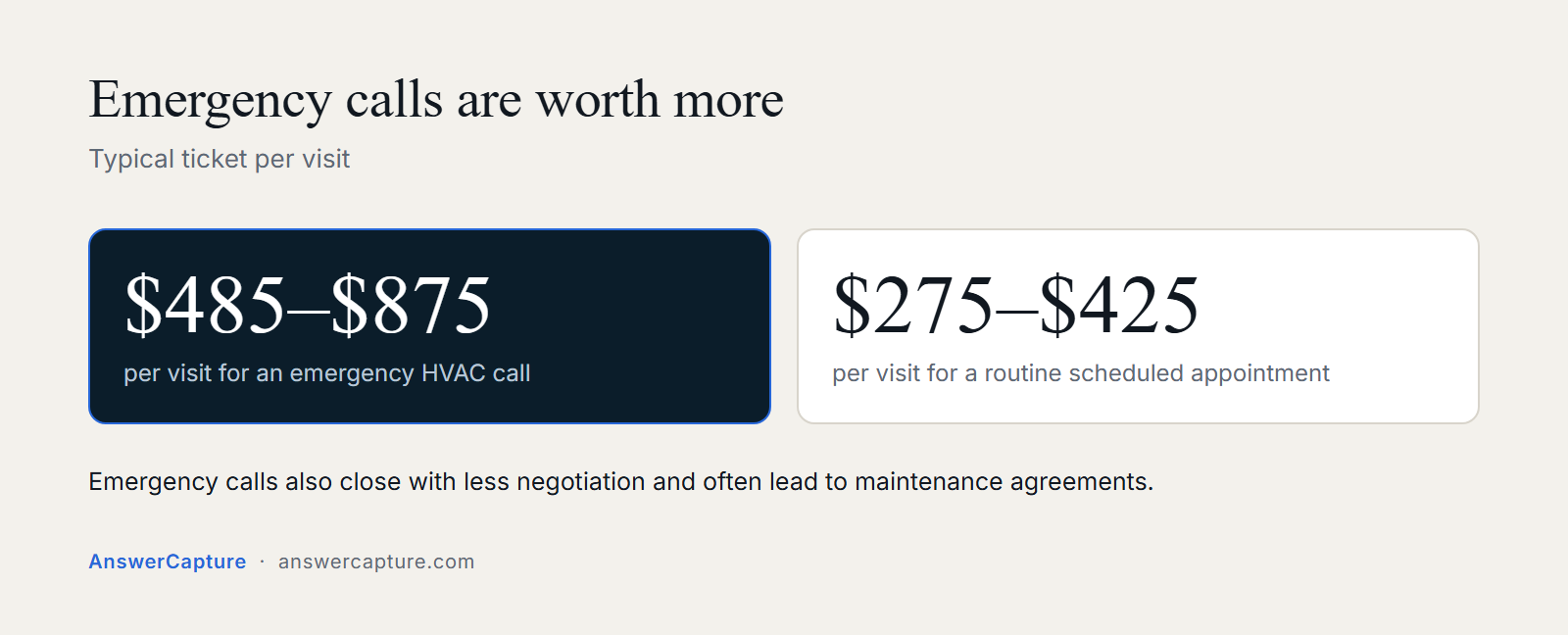
An emergency HVAC call isn’t price-comparison traffic. It’s a homeowner in genuine discomfort who wants someone to fix the problem tonight. These calls close at higher ticket values, often lead to maintenance agreements, and generate repeat business over years. Emergency jobs typically run $485 to $875 per visit, compared to $275 to $425 for a routine scheduled appointment, and they close with less negotiation.
The results that proper call coverage produces are consistent across operations of different sizes. The recovered revenue comes from closing the gap between calls received and calls actually answered.
Most HVAC owners believe they’re converting most of their inbound demand. The data tells a different story. When after-hours and overflow calls are factored in, conversion rates commonly sit at 60 to 70%. The revenue sitting in that gap doesn’t require more ad spend. It requires a system that answers and books what’s already coming in.
Choosing an after-hours answering service for HVAC: top features
A generic answering service takes a message. A proper HVAC phone answering and dispatch system runs triage. That means detecting emergency keywords like “no heat,” “AC out,” or “gas smell” and immediately escalating those calls to the on-call technician via a defined protocol, not a voicemail relay, but an actual escalation chain with documented response times. If a provider can’t walk you through their emergency escalation process in specific terms, they don’t have one.
Scheduling and CRM integration
Real-time scheduling capability is the other critical differentiator. The question to ask is simple: does the service check live calendar availability and commit to an appointment window during the call, or does it promise a callback and hand the problem back to you? Native integrations with platforms like ServiceTitan, Housecall Pro, Jobber, and Workiz mean call data, contact records, and job details sync automatically rather than requiring manual entry after the fact. That sync eliminates double-handling and gives your team full context before they ever reach the job.
HVAC-specific intake scripts
Generic call scripts fail HVAC owners because they don’t ask the right questions. A properly configured intake script for HVAC calls captures equipment type, property type, and urgency level. It also flags issue description and homeowner or renter status before a technician is ever contacted. That’s the difference between a dispatch-ready job and a technician showing up with no information. Top-tier services document their SLAs as well: best-in-class HVAC call center providers target missed-call response under 60 seconds and back their answer rate with a written guarantee.
If you serve markets with significant Spanish-speaking populations, confirm bilingual English/Spanish support before signing anything. The better providers include it as standard; it shouldn’t require an upgrade.
After-hours answering service for HVAC, pricing and ROI
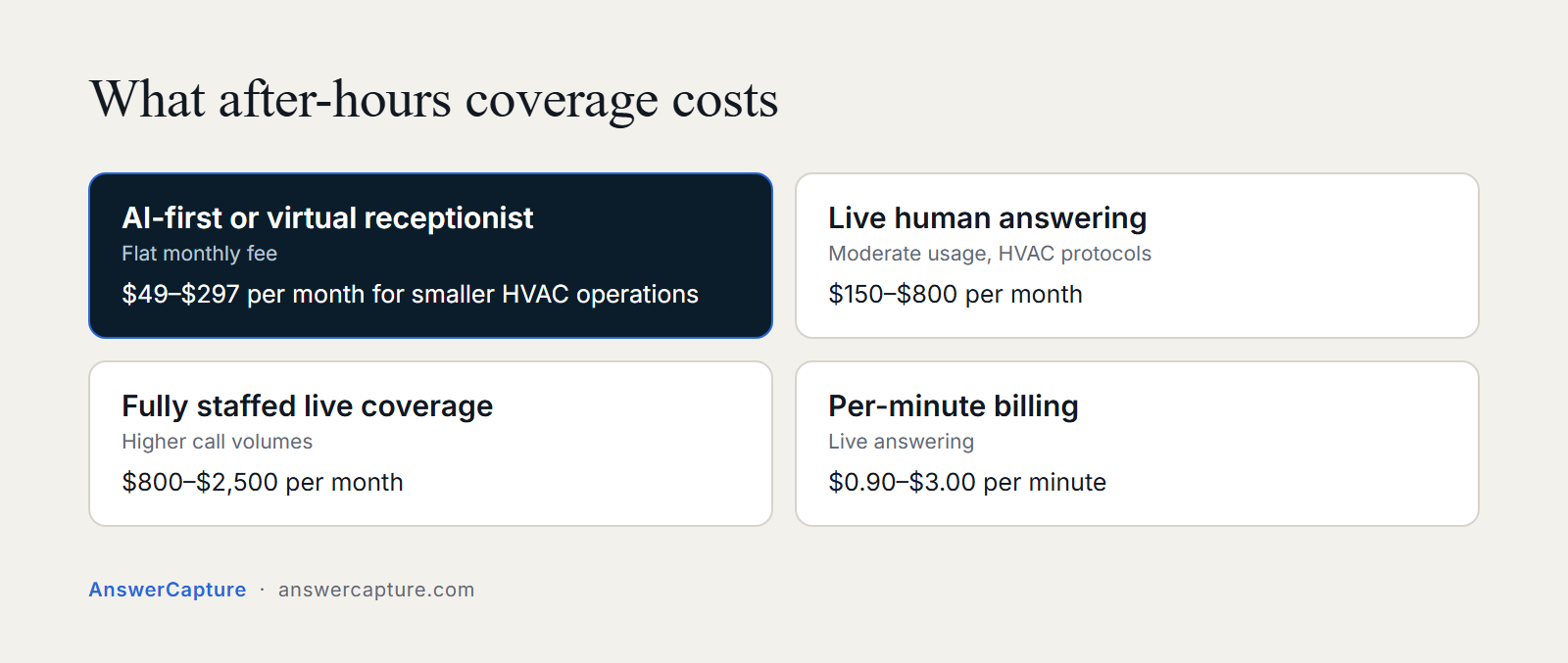
Three pricing models dominate the market. Flat monthly fees are most common for AI-first and virtual receptionist options, typically running $49 to $297 per month for smaller HVAC operations. Live human answering with HVAC-specific protocols commonly falls in the $150 to $800 per month range for moderate usage, with fully staffed live coverage reaching $800 to $2,500 per month for higher call volumes. Per-minute billing for live answering usually runs $0.90 to $3.00 per minute; per-call billing often lands at $1.50 to $7 depending on provider and service level.
Running the numbers
The ROI math is straightforward. If the average HVAC job in your market is worth $400 and the service costs $300 per month, you need to capture one additional job per month to break even. Capturing even that one extra job is a low bar when after-hours calls are otherwise going to voicemail. Run the numbers against your own average ticket and your current call volume, and the break-even point becomes obvious.
How to onboard without disrupting your current operations
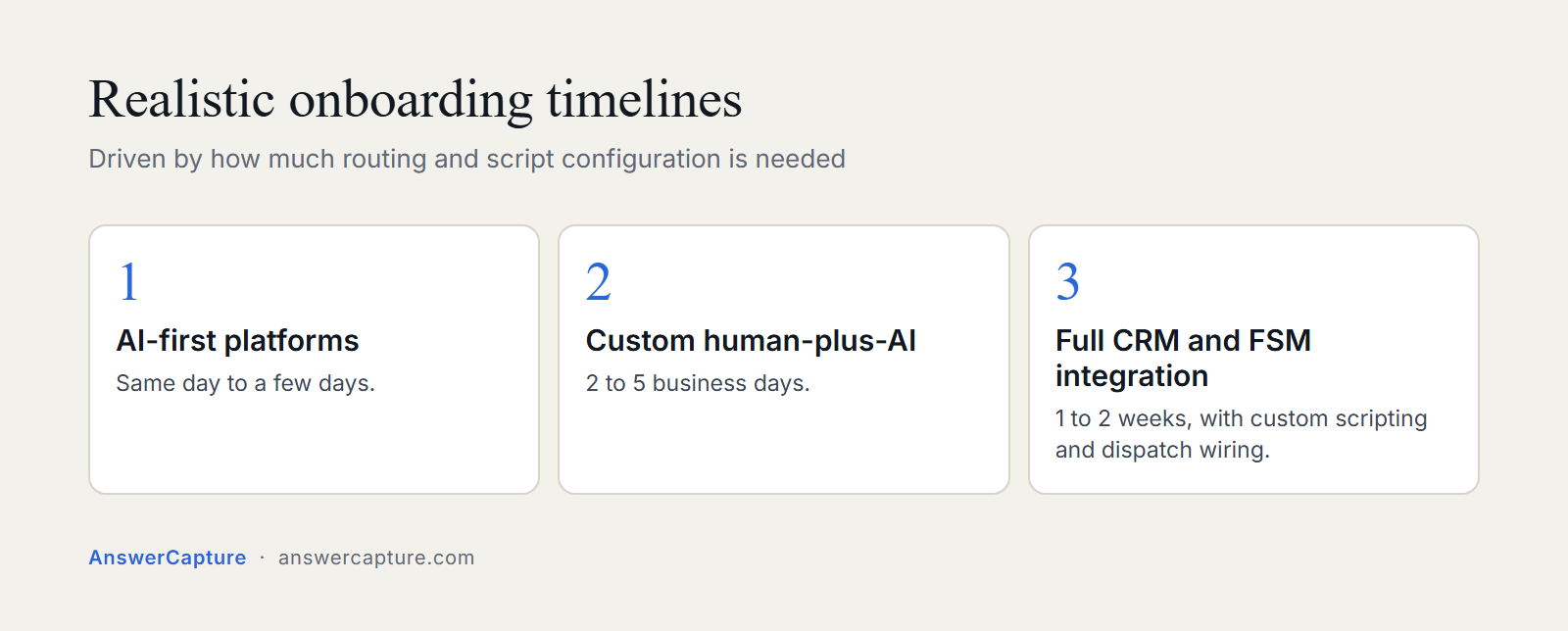
Realistic onboarding timelines depend on complexity, not the basic phone-forwarding step. AI-first platforms can go live same day to a few days. Customized human-plus-AI setups typically take 2 to 5 business days. Full CRM and FSM integrations with custom scripting and dispatch wiring generally take 1 to 2 weeks. The timeline is driven almost entirely by how much routing logic and script configuration is needed.
Integration sequence
The integration sequence that actually matters follows a logical order. Start by defining call routing rules, including hours, emergency criteria, and escalation paths. Next, connect scheduling so availability can be checked in real time. Then wire in the CRM or FSM and configure intake scripts. Finally, test everything end to end before forwarding the main line. The right provider handles most of this for you, a done-for-you implementation means you review and approve the workflow, not build it from scratch.
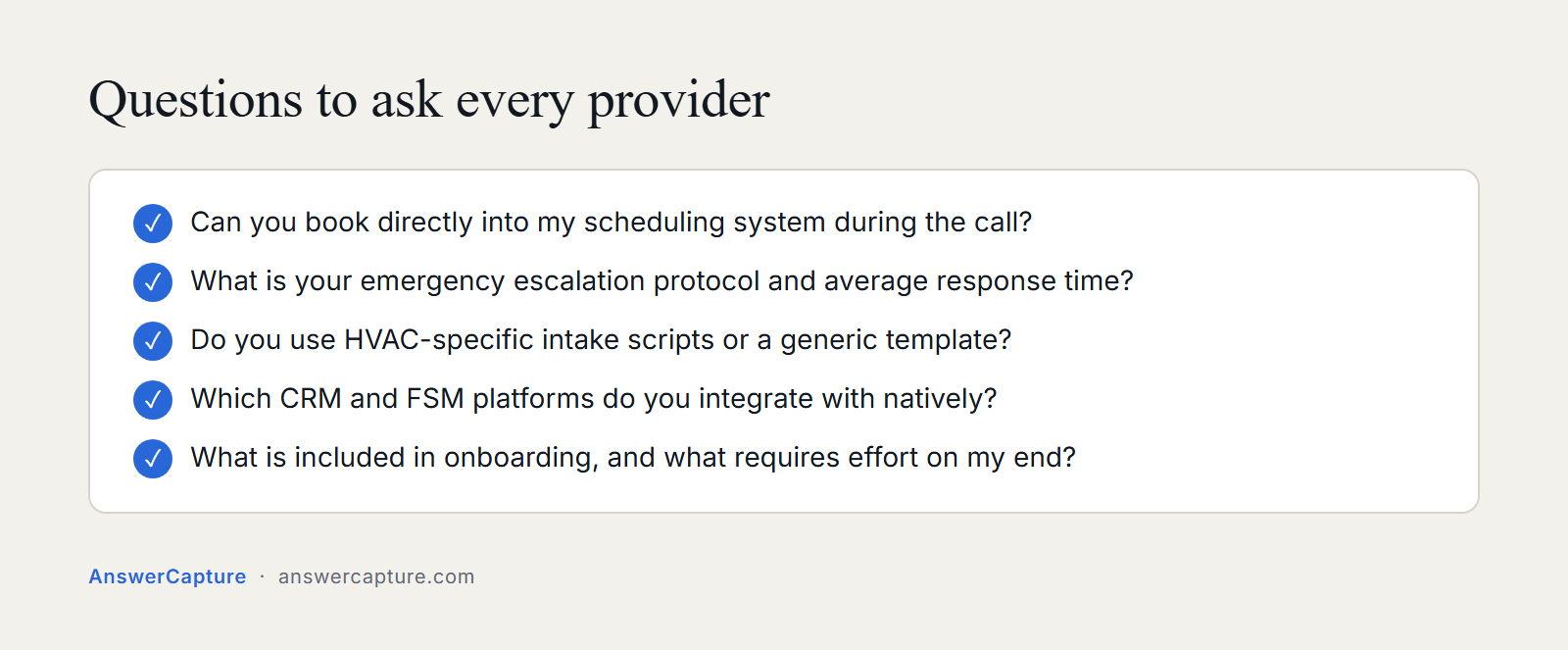
Before committing to any provider, ask these questions directly:
- Can you book directly into my scheduling system during the call?
- What is your emergency escalation protocol and average response time?
- Do you use HVAC-specific intake scripts or a generic template?
- Which CRM and FSM platforms do you integrate with natively?
- What is included in onboarding, and what requires effort on my end?
Watch for these red flags: providers that can only take messages rather than book appointments, scripts that have no HVAC context, vague SLA language, and onboarding processes that require significant technical work from you. A provider that can’t answer these questions clearly during a sales conversation won’t perform better once you’ve signed the contract.
Why AnswerCapture captures after-hours HVAC calls differently
AnswerCapture was built by a retired NYC Fire Department officer and former HVAC business owner who operated on both sides of this problem. The emergency-response discipline that shapes every protocol at AnswerCapture isn’t a marketing angle; it’s the same zero-failure communication logic applied to inbound call infrastructure. That operational foundation is what separates AnswerCapture from a repurposed answering service or a chatbot bolted onto a phone line.
Every after-hours HVAC call that reaches AnswerCapture’s infrastructure is answered, triaged by urgency, and either booked directly into your calendar or escalated to your on-call technician, automatically, without you managing anything. CRM logging and call summaries give you full visibility into every customer interaction without manual follow-up. The entire implementation is handled by the AnswerCapture team; you review the workflow, approve the script, and the system runs without requiring your technical involvement.
The honest question every HVAC owner should sit with: how many after-hours calls hit voicemail this week, and where did those homeowners go next? AnswerCapture offers a live call demo so you can experience the system the same way a customer would when they call after hours and someone actually picks up. Reach out to the AnswerCapture team to see it in action before making any commitment.
The bottom line on after-hours call coverage for HVAC
An after-hours answering service for HVAC isn’t an administrative expense; it’s infrastructure for capturing demand that already exists. The evaluation criteria are clear: emergency dispatch capability, real-time booking into your scheduling system, HVAC-specific intake scripts, native CRM integration, and a pricing model that breaks even on a single recovered job per month.
The revenue sitting between calls received and jobs actually booked doesn’t require more advertising. It requires a system that answers reliably, every night, every weekend, and through every peak-season surge, without adding headcount or complexity to your operation. That system exists, and the only remaining question is how much longer you want to leave those jobs on the table.