The caller who hits your voicemail at 7 p.m. on a Friday isn’t going to leave a message and wait. They’re going to call the next contractor in the search results. You already know this because you’ve watched it happen, or at minimum you’ve felt it in the gap between inbound calls and jobs actually on the calendar. A home services answering service is supposed to close that gap. The problem is that most of them are built for general office environments, not for the way phone-driven service businesses actually operate. Understanding what separates a useful service from a placeholder is what helps you make the right call before signing a contract.
The market spans everything from $49/month AI tools that pick up the phone to infrastructure-level systems that triage calls, route emergencies, and book jobs in real time without any manual oversight from you. Price alone doesn’t tell you which one will actually capture revenue. The capability behind the price point does.
What a home services answering service actually does
At its most basic, an answering service picks up inbound calls when you can’t. For a home service business, that definition undersells the job. The person calling about a burst pipe at midnight is a different situation than someone requesting a quote for a spring AC tune-up, and your answering service needs to know the difference. A service that treats every call the same way will lose you the high-value emergencies while spending time logging routine inquiries.
The best answering services for home service businesses operate across a full call-to-job pipeline. That means answering, triage, routing, and booking, not just taking a name and a number for you to follow up with in the morning. A message-taking service adds to your workload. A properly built inbound call system removes it.
Message-taking vs. call triage and dispatch logic
A basic answering service logs the caller’s name and callback number. A home-service-specific service goes further: it identifies whether the call is an emergency or a routine request, determines what trade is involved, and routes the call according to priority logic. That distinction matters most at 10 p.m. when a gas smell call comes in alongside three quote requests. Emergency routing sends the right call to the right person immediately. A message log sends everything to voicemail.
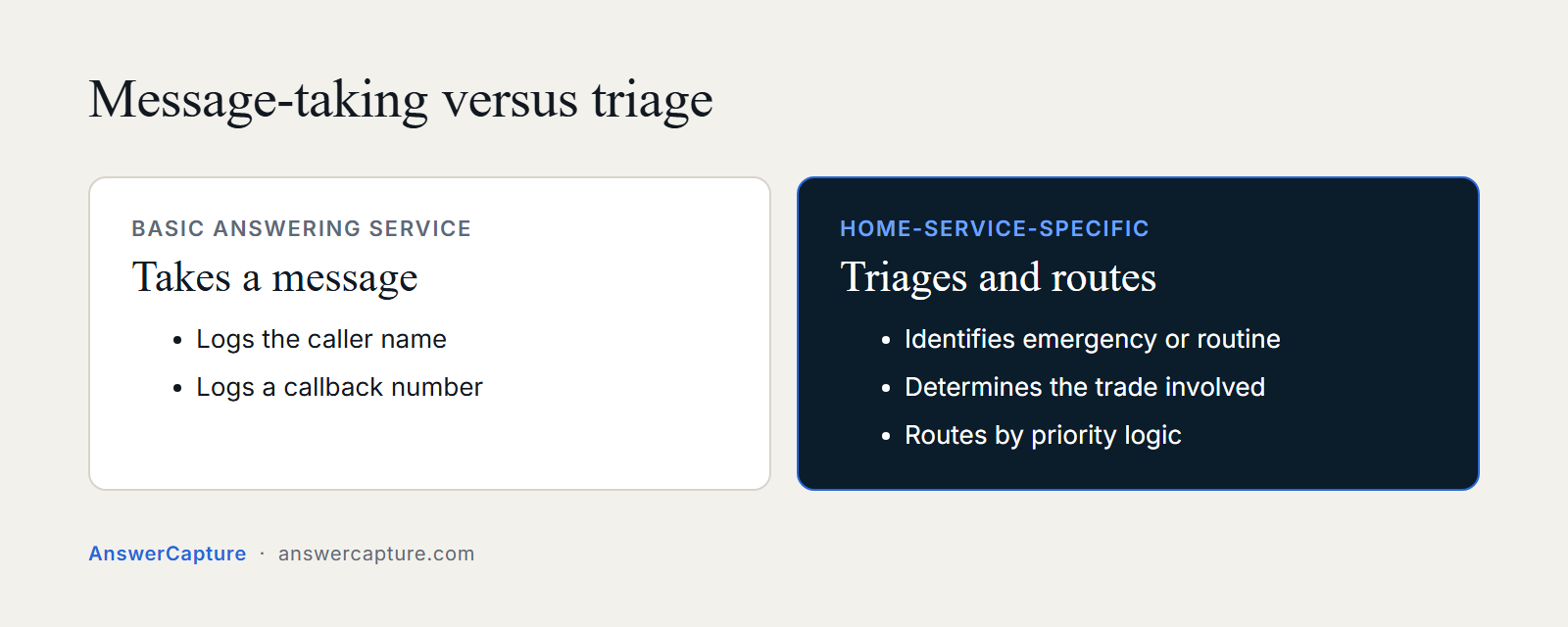
Dispatch logic is what separates answering services that are built for trades from ones that are merely marketed to them. Services with pre-built escalation protocols for HVAC, plumbing, and electrical scenarios can respond to a flooded basement call with the right action and the right technician, not a generic script read by an agent who’s never heard the term “pressure relief valve.”
The job-booking capability most services skip
A large share of answering services can answer the phone and capture a lead. Far fewer can actually put an appointment on your calendar before the caller hangs up. No-touch booking, where the service integrates directly with your scheduling platform and confirms the job in real time, is the capability that closes the loop between inbound demand and confirmed revenue. Without it, you still have a callback list to work through every morning, which means some of those leads will go cold before you reach them.
When evaluating any provider, the booking question is non-negotiable. Can they book into your actual scheduling system, or are they handing you a lead to follow up with yourself? The businesses that get this wrong spend money on coverage and still lose jobs at the follow-up stage.
How a home services answering service differs from a generic call center
A general-purpose call center trains agents to handle a wide range of industries through scripted responses. That approach works well enough for appointment reminders and basic customer service, but it breaks down quickly in trade scenarios. An agent who doesn’t understand what a heat exchanger is, or why a sewage backup call outranks a quote request, can’t make the judgment calls that protect your revenue and your customers.
Industry knowledge and scripted workflows built for trades
Trade-specific answering services train their staff, or their AI systems, on HVAC, plumbing, and electrical terminology. They know which intake questions matter for an accurate job record and how to handle a caller who’s panicking about a flooded basement differently than one scheduling a routine visit. This isn’t a minor detail. Getting the intake wrong means dispatching the wrong tech with the wrong parts, or booking a two-hour job into a 45-minute slot.
Emergency routing and after-hours call protocols
After-hours coverage that actually works requires more than someone picking up the phone at 2 a.m. It requires a priority routing system that distinguishes between calls that need an on-call tech immediately and calls that can wait for the morning queue. Generic call centers rarely have that logic built in. Home-service-focused services, and AI-powered infrastructure like AnswerCapture, have it configured from the start. The result is that your emergency calls reach someone who can act, and your routine calls don’t wake up your technician for a maintenance quote.
The features trade businesses need most from a home services answering service
Not every feature in a provider’s marketing deck matters equally to a plumber or an HVAC contractor. The four capabilities below are the ones that directly affect whether inbound demand becomes booked revenue, or becomes a list of callbacks you didn’t get to in time.
24/7 coverage that actually holds up during peak demand
True 24/7 coverage means no calls go to voicemail during a summer AC surge, no leads disappear over a holiday weekend, and no competitor picks up a job because your line was busy. Before signing with any provider, verify what “24/7” actually means in their contract. Some services use live agents during business hours and switch to AI or voicemail after hours. Others scale back staffing on weekends. Ask specifically how their coverage model handles peak call volume, not just off-peak hours.
Real-time appointment booking into your scheduling system
The standard to aim for is a booked appointment before the caller hangs up. That requires a direct integration with your scheduling platform, whether you’re running ServiceTitan, Housecall Pro, Jobber, or Google Calendar. A service that emails you a lead and asks you to call back is adding a step, not removing one. At high call volumes, that extra step is where jobs get lost.
CRM logging, call summaries, and compliance basics
Every inbound call should leave a record: who called, why, what was agreed, and when. Good answering services log call details and sync them to your CRM automatically, giving you full visibility into every customer interaction without manually tracking anything. For home health businesses specifically, HIPAA compliance is a separate requirement. Look for providers who will sign a Business Associate Agreement and use encrypted messaging for patient communications. For most trade contractors, the priority is simply ensuring no call goes unrecorded and no lead gets lost between the phone and the calendar.
Live agents vs. AI answering infrastructure: what each model delivers
The market has split into two distinct models. Traditional answering services staff live agents who handle calls in real time. AI-powered systems manage calls through automated voice and booking workflows. Both serve real needs, but the right choice depends on your call volume, your budget, and how much system management you’re willing to take on.
When live agents make sense
Live agents are the right call when your business handles complex, emotionally sensitive situations where a human voice matters. High-end custom work, elderly clientele, or calls that require real-time nuance and judgment are better handled by a person than an automated system. The tradeoff is cost: most live agent services charge per minute, and pricing climbs fast at high volume. A contractor fielding 300 calls a month on a per-minute plan will spend substantially more than one on a flat-rate model with comparable coverage.
When AI infrastructure wins for high-volume contractors
For most trade businesses handling high call volumes across multiple shifts, AI-powered infrastructure is faster, more consistent, and more cost-effective than a live agent pool. Because AI systems answer instantly and never go off shift, they eliminate the most common source of missed calls: the gap between when the phone rings and when someone picks up. According to industry deployment data, well-implemented AI or 24/7 answering infrastructure can push contractor booking rates into the 70, 85% range, a meaningful improvement over the 42, 50% baseline typical of businesses relying on voicemail or inconsistent manual answering. That improvement comes directly from closing the gap between answered calls and booked jobs.
AnswerCapture operates at this layer. It’s not a per-minute phone service, it’s a done-for-you revenue capture infrastructure that handles call triage, emergency routing, real-time booking, and CRM logging as a complete system. You don’t manage it. It runs. Every inbound call moves through a pipeline built to convert leads into booked jobs, not messages to return.
Provider comparison: who’s in the market and what they charge
The market spans a wide range of price points and capabilities. Here’s how the current options break down for home service businesses:
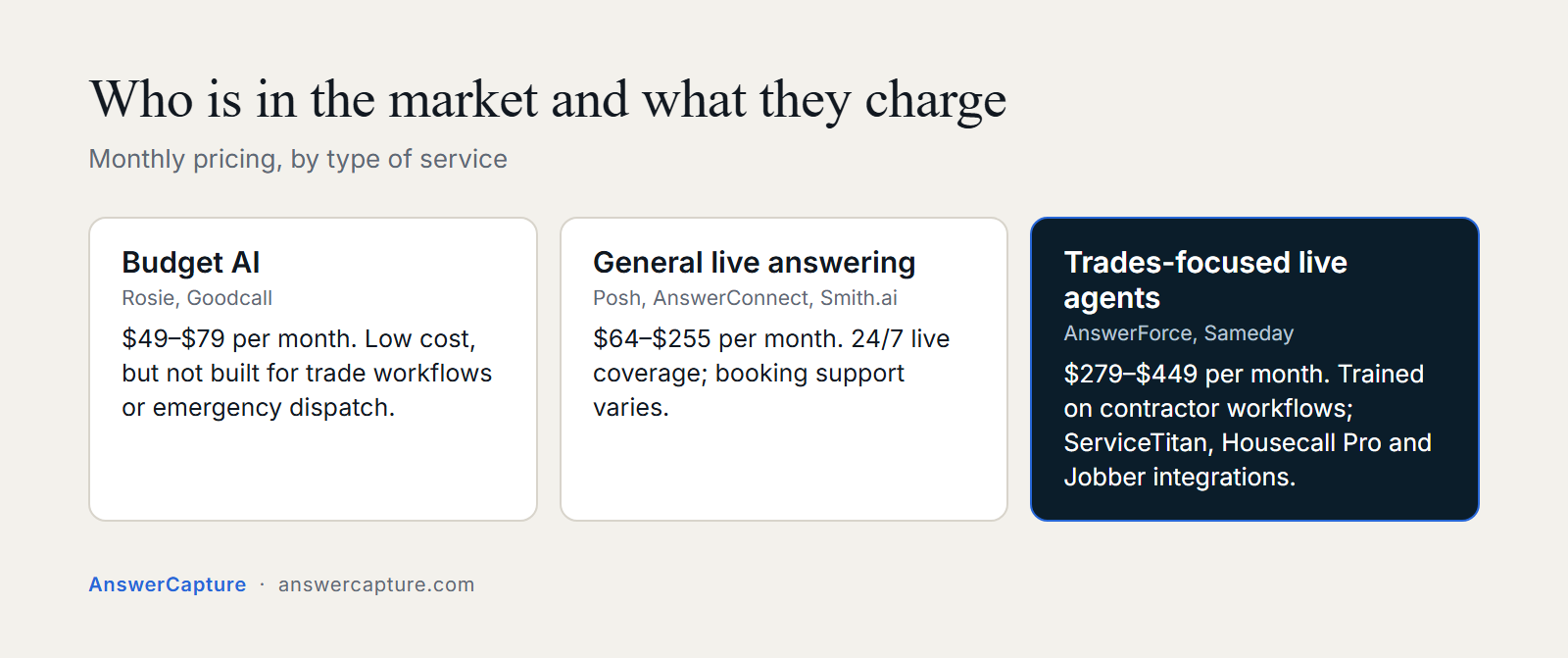
- Budget AI options ($49, $79/month): Rosie ($49/month, 250 minutes) and Goodcall ($79/month, unlimited minutes) offer automated answering at low cost. These work as a starting point for low-volume businesses but aren’t built for trade-specific workflows or emergency dispatch.
- General live-answering services ($64, $255/month): Posh, AnswerConnect, and Smith.ai offer 24/7 live coverage with varying booking capabilities. They handle calls around the clock but differ significantly in how much they support actual job dispatch and real-time calendar booking. Pricing typically runs on per-minute or per-call models, which adds up quickly at high volume.
- Trades-focused services ($279, $449/month): AnswerForce ($279/month) and Sameday ($449/month) are built for home service contractors. Both offer live agents trained on contractor workflows and direct integrations with ServiceTitan, Housecall Pro, and Jobber. These are solid live-agent options for HVAC and plumbing businesses that prioritize human coverage.
AnswerCapture operates at a different layer than the providers above. Rather than charging per minute or per call for an agent reading a script, it deploys a done-for-you infrastructure that manages the entire inbound call pipeline as an integrated system. For business owners who want complete coverage without managing vendors, staffing schedules, or call scripts, that’s a fundamentally different value proposition than anything in the traditional per-minute market.
Questions to ask before you commit to a provider
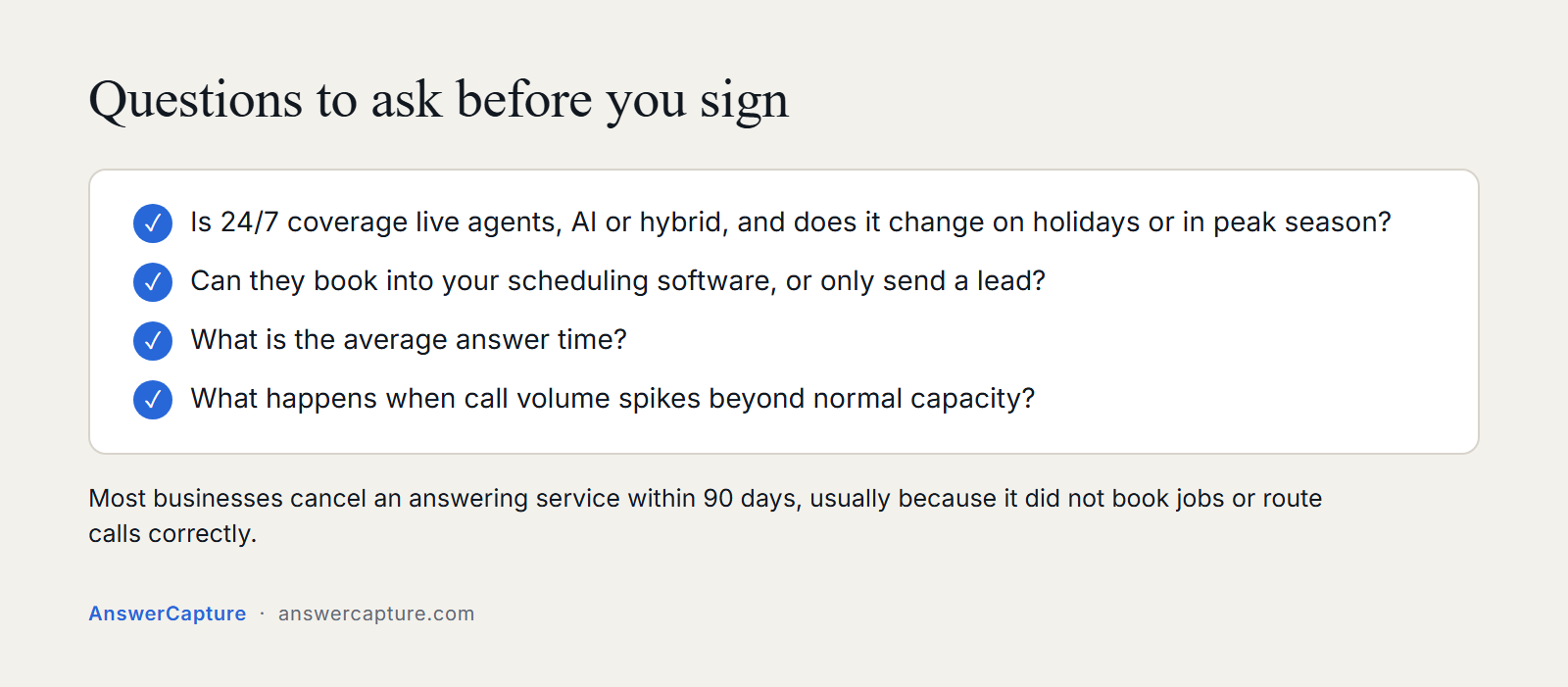
Most businesses cancel their answering service within 90 days. The most common reason: the service didn’t actually book jobs or route calls correctly, and the owner didn’t realize it until they’d already lost several weeks of leads. Asking the right questions before signing prevents that outcome.
Coverage and booking questions
Ask whether their 24/7 coverage uses live agents, AI, or a hybrid, and whether that model changes on holidays or during peak demand periods. Confirm whether they can book directly into your scheduling software or only send a lead for you to follow up with. Ask about average answer time and what happens when call volume spikes beyond their normal capacity. These questions expose the gaps that marketing copy won’t mention.
Integration, reporting, and accountability questions
Ask which CRM and field service platforms they integrate with natively, and whether that integration is real-time or delayed by a sync cycle. Ask how you’ll receive call summaries and whether you can review recordings or transcripts. Ask what their escalation protocol looks like for emergency calls and how they define an emergency in your specific trade. A provider who answers these questions clearly and specifically has a system that was actually built for your business. One who answers vaguely is marketing to you, not serving you.
Frequently asked questions about home services answering services
What should a home services answering service actually do beyond taking messages?
A purpose-built home services answering service should handle the full intake process: identifying the caller’s need, triaging emergency vs. routine requests, booking appointments directly into your scheduling system, and logging every interaction to your CRM. Message-taking is the floor, not the goal. The businesses that get the most value from answering coverage are the ones using it to convert inbound calls into confirmed jobs, not to generate a callback list.
Is a virtual receptionist for home service companies different from a standard answering service?
In most cases, yes. A virtual receptionist handles a broader range of front-desk functions, intake, scheduling, follow-up communications, and is typically configured around your specific workflows. A standard answering service answers calls and takes messages. For contractors, the more relevant question is whether the service can actually book jobs and route emergencies, regardless of how the provider labels the product.
What does a home services answering service typically cost?
Pricing ranges from $49/month for basic AI call-answering tools to $449/month or more for live-agent services built specifically for trades. Infrastructure-level systems like AnswerCapture are priced differently, as a complete inbound revenue system rather than a per-minute or per-call service. The right frame isn’t cost per month. It’s cost per booked job, and how many jobs your current setup is leaving on the table.
The right system turns your phone line into a revenue stream
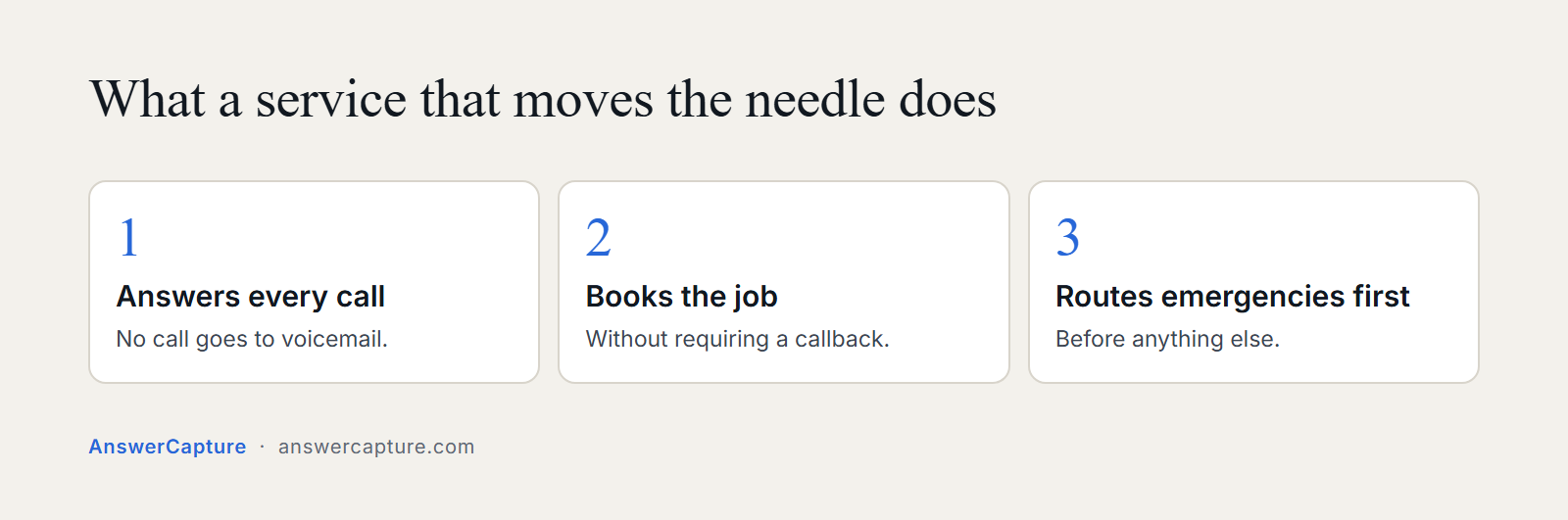
A home services answering service that moves the needle does three things well: it answers every call, books the job without requiring a callback, and routes emergencies before anything else. The provider market spans basic message-takers at $49/month to full answering infrastructure built for how trade businesses actually run. The difference between an adequate vendor and the right one usually comes down to whether they understand dispatch logic and booking integration, not just call volume.
For businesses already spending on advertising and generating inbound demand, the highest-return move isn’t more ad spend. It’s capturing the leads that are already calling. If your current setup is converting 60, 70% of inbound calls into booked jobs, you’re leaving a third of your marketing investment on the table. The right infrastructure closes that gap without adding headcount, without adding management overhead, and without hoping callers leave a message.
If you want to hear what a fully built answering system sounds like before you commit to anything, AnswerCapture offers a live call demo so you can experience the infrastructure firsthand. That’s the clearest way to know whether a system was built for your business, or just marketed to it.