Picture a 95-degree afternoon in July. Your technicians are running back-to-back calls, your office line is ringing, and a homeowner with a failed AC unit is dialing every HVAC company in the area. The first company that picks up gets the job. If that’s not your company, that’s a $600 to $1,200 service call walking out the door before you even knew it existed. Multiply that across a summer season and you’re looking at a structural revenue leak, one that an AI answering service for HVAC is specifically built to close.
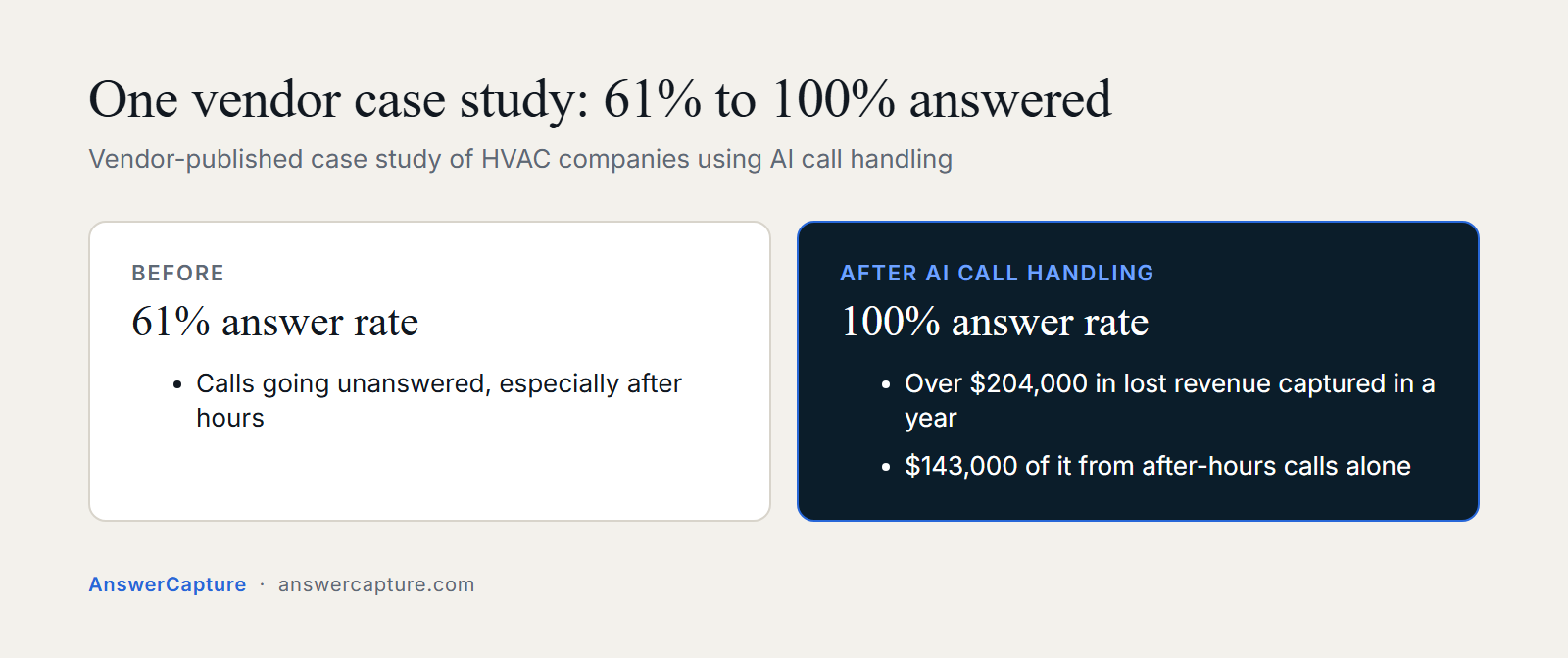
The data makes this concrete. According to a vendor-published case study, HVAC companies that improved their answer rate from 61% to 100% using AI-powered call handling captured over $204,000 in previously lost revenue in a single year, including $143,000 recovered from after-hours calls alone. That’s not revenue they generated with a bigger ad budget. That’s revenue that already existed in the form of homeowner demand, just never captured because no system was answering. By the end of this article, you’ll understand exactly how AI phone answering for HVAC contractors works, what real costs look like across the market in 2026, and what questions to ask every vendor before you commit. AnswerCapture, a done-for-you system built around this exact revenue gap, is one option we’ll cover in detail.
How an AI answering service for HVAC companies works
The mechanics are simpler than most owners expect. A call comes in and the AI picks up on the first ring. No voicemail. No hold music. The system identifies whether the caller is a new lead, an existing customer, or a non-billable contact, then collects the job-relevant basics: name, address, system type, and problem description. Vendors like Smith.ai, EngageAgents, and Avoca AI use conversation logic trained on service-industry scenarios, meaning intake typically wraps up in a few minutes rather than putting a caller through a generic customer service loop.
Call capture and intent recognition
When the AI answers, it’s not playing a phone tree. It’s running a structured conversation designed to pull the information a dispatcher would need: what’s wrong, where the property is, and how urgent the situation is. The call never reaches voicemail, which matters because a widely cited lead response study found that waiting five minutes to respond to a new inquiry reduces qualification odds by roughly 80%. A homeowner who calls three HVAC companies and gets two voicemails is booking with whoever picked up, often before your team even knows the call came in.
Priority routing based on urgency
This is where HVAC-specific configuration separates a real AI answering system from a generic virtual receptionist. The system applies triage rules built for your trade: a gas smell, a carbon monoxide alarm, no heat with outdoor temperatures near freezing, and AC failure with elderly or medically vulnerable occupants all trigger immediate escalation. A routine tune-up request gets sorted into the next available booking slot. The routing logic runs the same way at 2 p.m. on a Tuesday as it does at 11 p.m. on a Saturday.
Real-time booking without staff involvement
After triage, the system checks live calendar availability and books the appointment directly, sending confirmation to both the caller and the business owner. This is the no-touch booking model: the job is captured while your tech is still finishing a call across town, and no one in your office touched the interaction. The technician gets the job brief; the homeowner gets a confirmation text. The whole loop closes before anyone on your team even sees the missed call notification.
Where HVAC companies lose the most revenue
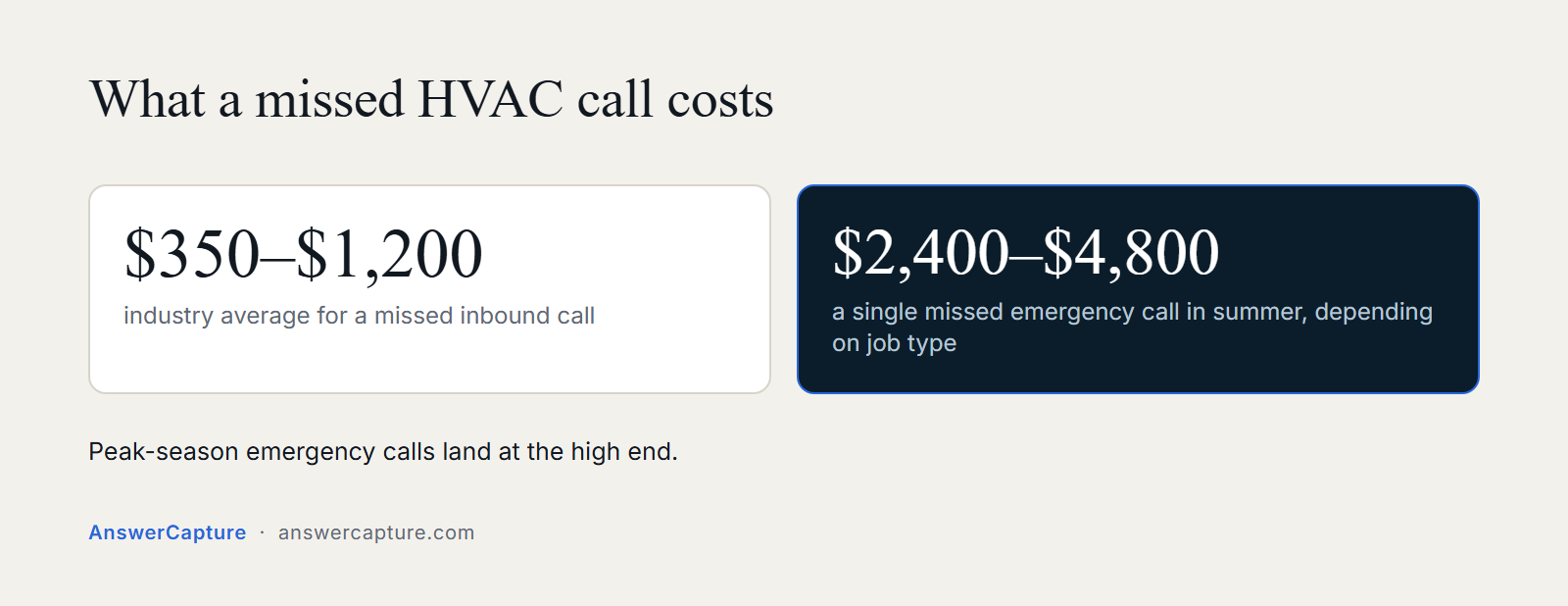
Most HVAC owners know they miss calls. Few of them have actually calculated what those missed calls cost. The industry average for a missed inbound call runs between $350 and $1,200, with peak-season emergency calls landing at the high end. During summer AC demand spikes, a single missed emergency call can represent $2,400 to $4,800 in lost revenue depending on the job type.
The peak season call overflow problem
During a heat wave, inbound call volume can outpace a well-staffed office by mid-morning. A homeowner calling three HVAC companies isn’t loyal to any of them, they’re booking whoever answers first. Same-day response speed is often the only factor that determines which company gets the job. An AI virtual receptionist for HVAC levels that playing field because it answers every call regardless of how slammed the rest of the operation is. These systems provide 24/7 HVAC call answering, so you never miss a peak-hour rush or an after-hours emergency.
The after-hours lead gap most owners undercount
The $143,000 after-hours recovery figure from the case study isn’t an outlier. It reflects a straightforward reality: homeowners don’t wait until 8 a.m. to call about a failed AC unit. They call when the problem happens. If your phone system sends those calls to voicemail, that revenue goes to whichever competitor has coverage. The demand already exists, the only question is whether your infrastructure captures it.
How AI handles after-hours HVAC emergency calls
The after-hours scenario is where most owners have the most skepticism, and it’s also where a well-configured AI answering system creates the clearest return. At 11 p.m., when a homeowner’s AC dies during a heat advisory, the system answers the call and runs through urgency qualification before anything else.
Urgency qualification: separating emergencies from morning calls
The triage questions are specific: Is the system completely down, or just underperforming? Are there elderly, infant, or medically vulnerable occupants in the home? Is there a gas smell, carbon monoxide alarm, or any sign of a safety hazard? The AI routes based on those answers, not on whether a dispatcher happened to be awake. A true emergency triggers dispatch. An inconvenient but non-dangerous situation gets booked for the first morning slot with a confirmation text so the homeowner knows they’re on the schedule.
Immediate dispatch vs. next-morning scheduling
When a call qualifies as an emergency, the system sends an immediate SMS alert to the on-call technician with the caller’s name, address, problem description, and contact number. If the primary on-call tech doesn’t respond within a defined window, the system escalates automatically to a secondary contact or backup technician. No one has to monitor the phone. The escalation logic runs on its own, the same way every time, whether it’s a weeknight or a holiday weekend.
Automated booking and CRM integration for HVAC
A common buyer concern is whether these systems actually connect to the platforms HVAC companies already run. The short answer is that the best ones do, but the quality of that connection varies by vendor and matters more than most buyers initially realize.
Which platforms these systems connect to
The main dispatch and CRM platforms in the HVAC space are ServiceTitan, Jobber, and Housecall Pro. Several AI answering services offer direct ServiceTitan integration, including EngageAgents, Avoca AI, and Broccoli AI, which can push job records into the ServiceTitan dispatch board in real time. Fewer vendors have confirmed native integrations with Jobber and Housecall Pro; many rely on API or webhook-based workflows for those platforms. That distinction matters for reliability and setup complexity. A native integration is more stable. An API-dependent setup introduces more potential failure points, and that’s worth asking about directly before you sign anything.
What a no-touch booking workflow looks like in practice
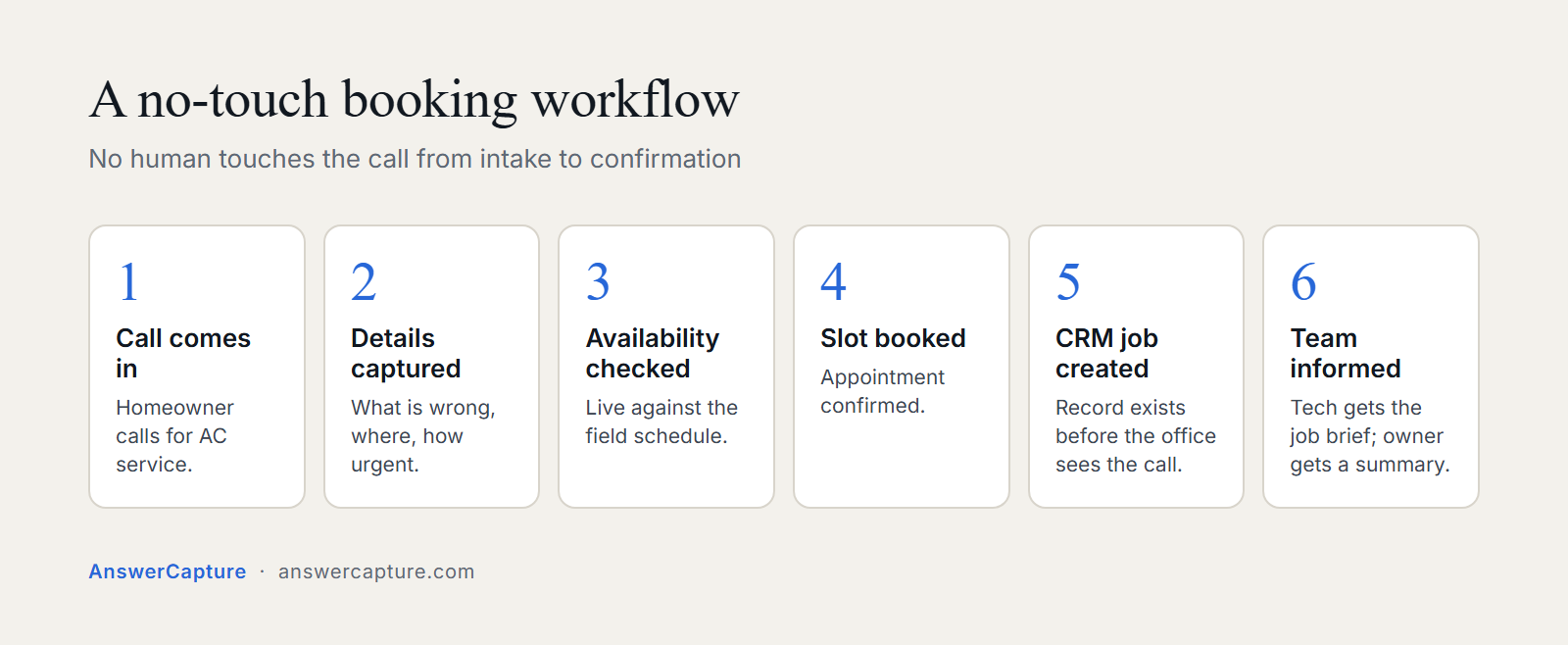
Here’s the complete flow: a homeowner calls for AC service, the AI captures the job details, checks live availability against the field schedule, books the appointment slot, creates the job record in the CRM, and sends the technician the job brief before anyone in the office sees the call. The owner gets a summary notification. No human touched the call from intake to confirmation. HVAC companies are adopting AI-assisted dispatch and booking at an accelerating pace in 2026 as the operational results become harder to ignore.
What an AI answering service for HVAC actually costs
This is where pricing gets complicated, because the headline monthly rate is rarely the full number. The market in 2026 spans a wide range, and the gaps between plans are significant enough to affect your actual return.
Pricing tiers across the market
The market breaks into three broad tiers. Entry-level AI-only plans, providers like Rosie (around $49/month) and QuoteIQ (around $29.99/month), cover basic answering and routing. Mid-tier options add booking integrations and emergency routing; Goodcall and NextPhone’s $199 flat-rate plan fall in the $95 to $200 range. Hybrid AI-plus-human-fallback services, with Smith.ai as the most commonly cited example, run $200 to $300-plus per month depending on call volume. Done-for-you infrastructure models like AnswerCapture’s reflect the full cost of implementation, CRM logging, emergency triage configuration, and ongoing system management, pricing built around solving the revenue capture problem end-to-end rather than licensing a software seat and leaving setup to you. Check each vendor’s current pricing page, as rates shift frequently.
Hidden costs to ask about before you sign
Per-minute and per-call fee structures are the most common surprise. Some plans that look affordable at the base rate become expensive during peak season when call volume spikes. Traditional answering services often charge $0.75 to $2.00 per minute; some AI platforms pass through telephony costs separately even when the base plan looks low. Watch for these specific add-on categories that are frequently gated behind higher tiers:
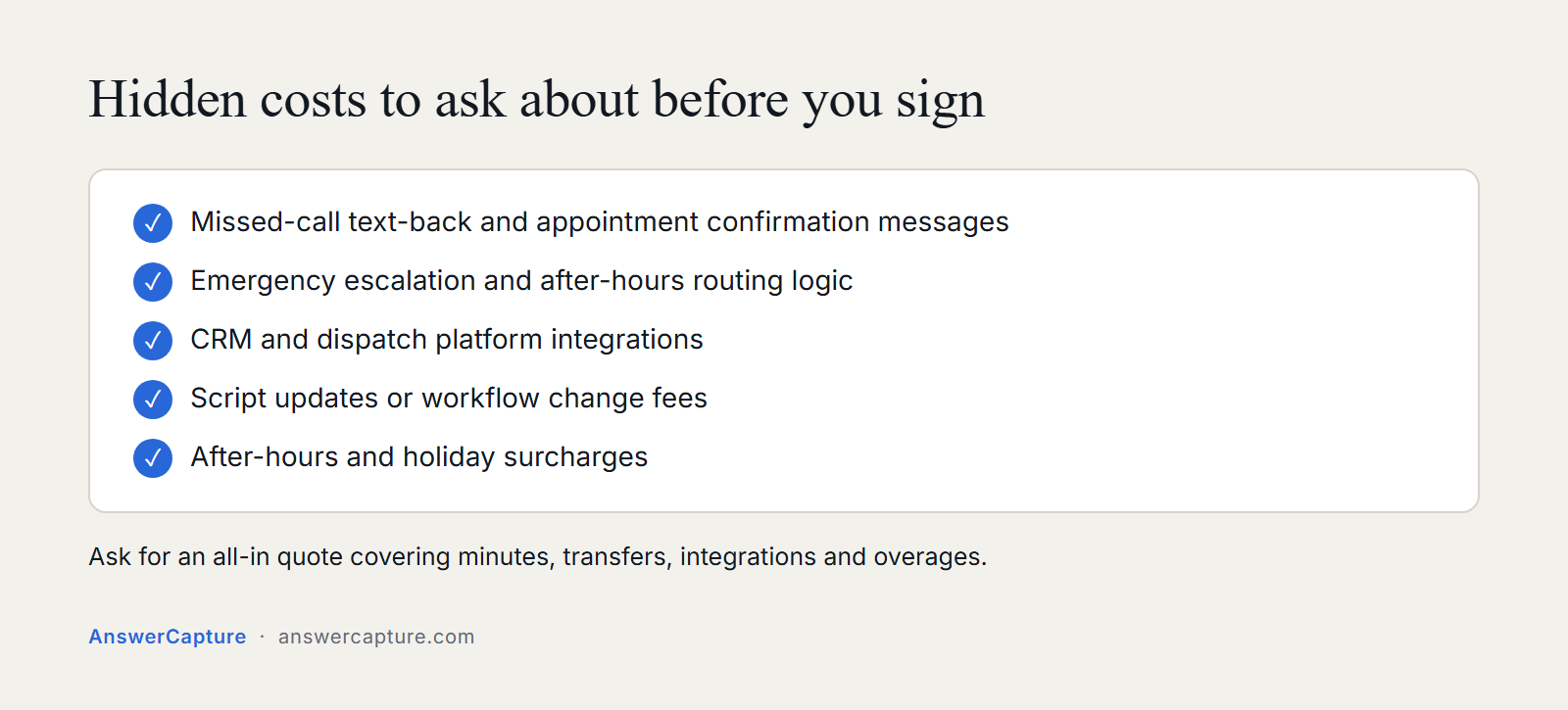
- Missed-call text-back and appointment confirmation messages
- Emergency escalation and after-hours routing logic
- CRM and dispatch platform integrations
- Script updates or workflow change fees when you revise call handling rules
- After-hours and holiday surcharges, which kick in at the exact times HVAC companies need coverage most
Implementation cost is a separate question. Self-serve setup takes minutes for basic plans, but a full HVAC-specific configuration with custom triage logic, CRM integration, and emergency escalation paths typically takes 5 to 10 business days and may carry a one-time setup fee. Ask every vendor for an all-in quote that covers minutes, transfers, integrations, and overages, then compare the effective cost per booked call rather than the monthly sticker price.
How to shortlist the right AI answering vendor for your HVAC business
The vendor landscape has enough options that narrowing your shortlist requires a clear framework. The right system for a solo operator running five calls a day looks different from the right system for a multi-truck operation handling 80 inbound calls during a heat wave week.
Questions to ask every vendor before you commit
These five questions separate vendors built for HVAC from generic call tools repurposed for the trade. Ask each one directly and push for specific answers, not marketing language.
- Does the system have HVAC-specific triage logic, or is it a generic call script with your company name inserted?
- Which dispatch platforms does it integrate with, and is that integration native or API-dependent?
- How are after-hours emergency calls handled differently from routine calls, and what triggers immediate dispatch?
- What happens when the system can’t resolve a call, and who escalates from there?
- Are there per-minute or per-call fees that activate during high-volume periods, and what does peak-season billing actually look like?
Why AnswerCapture is worth a closer look for HVAC revenue capture
AnswerCapture is built for HVAC owners who don’t want to manage a tool, they want the revenue problem solved. The system’s triage logic, booking workflows, and CRM integration reflect what an HVAC business actually needs, not what a generic AI platform can be configured to approximate. AnswerCapture handles implementation, configuration, and ongoing system management, so the owner’s only job is to show up for the booked jobs.
The system offers a live call demo so you can experience the actual call flow before committing. That removes the guesswork from the evaluation entirely. See pricing and integrations, or jump straight to the demo if you’d rather hear it in action first.
The infrastructure gap between your marketing spend and your booked jobs
An AI answering service for HVAC isn’t a luxury add-on for a well-staffed office. It’s the infrastructure layer that closes the gap between the calls your marketing budget generates and the jobs you actually book. HVAC companies that closed that gap saw their answer rates hit 100% and recovered over $204,000 in previously lost revenue in a single year, according to vendor case study data. Stop paying to drive calls you’re not capturing. Request a live call demo with AnswerCapture and run through the system on a real call before you make any decision.