Speed to lead for home services is decisive: a homeowner’s AC stops working at 6:45 PM on a Friday. She pulls up Google, finds three contractors, fills out a form on your website, and texts two others she found on Angi. Within 90 seconds, she’s waiting to see who responds first. Responding first substantially increases the chance of winning the job, often outweighing other factors such as reviews or price in the moment of inquiry. The other two contractors get nothing.
That scenario plays out thousands of times every day across HVAC, plumbing, electrical, roofing, and pest control. First response time isn’t a soft operational metric. It’s the variable that most directly controls how much of your inbound demand actually turns into booked revenue. A widely cited InsideSales.com study found that responding to a lead within 5 minutes makes you 21 times more likely to qualify that lead than waiting 30 minutes. Most contractors are waiting far longer than 30 minutes.
This article covers the specific benchmarks that separate booked jobs from missed ones, the operational gaps that create slow response times, a step-by-step workflow to get your first contact under 5 minutes, first-contact scripts you can use immediately, and the revenue math that makes the investment obvious. AnswerCapture was built specifically around this problem, treating every inbound lead with the same zero-failure urgency that emergency response demands. That context shapes everything that follows.
Why your response time is the biggest conversion lever you control
When a homeowner needs a plumber or HVAC technician, they’re not running a careful vendor evaluation. They’re contacting two or three contractors and going with whoever responds first with confidence. Loyalty plays almost no role at the moment of the inquiry. Speed does.
The moment a homeowner submits a form, misses a call back, or texts an inquiry, a clock starts. Most home service businesses don’t know that clock exists because nobody is watching it. Owners are in the field. Technicians are on jobs. The office phone rings and goes to voicemail, or a form submission sits in an inbox until someone checks email the next morning. That’s not a staffing problem. It’s a systems problem.
Homeowner urgency decays fast, especially for non-emergency requests. The longer the wait, the more the homeowner assumes you’re overbooked or uninterested, and they move on. Digital leads from Google Local Services Ads, Angi, Thumbtack, and website forms carry high purchase intent but also high perishability. A lead that submits at 7 PM on a Tuesday doesn’t wait until 9 AM Wednesday to hear back. By then, someone else has already confirmed an appointment.
Speed to lead for home services: benchmarks that separate booked jobs from missed ones
The conversion data by response-time interval is stark, and every home service owner should know these numbers. According to lead response research aggregated across home-services automation platforms, responding in under 2 minutes produces a 94% contact rate and a 41% booking conversion. Let that sink in: 4 out of 10 leads you reach within 2 minutes become booked jobs.
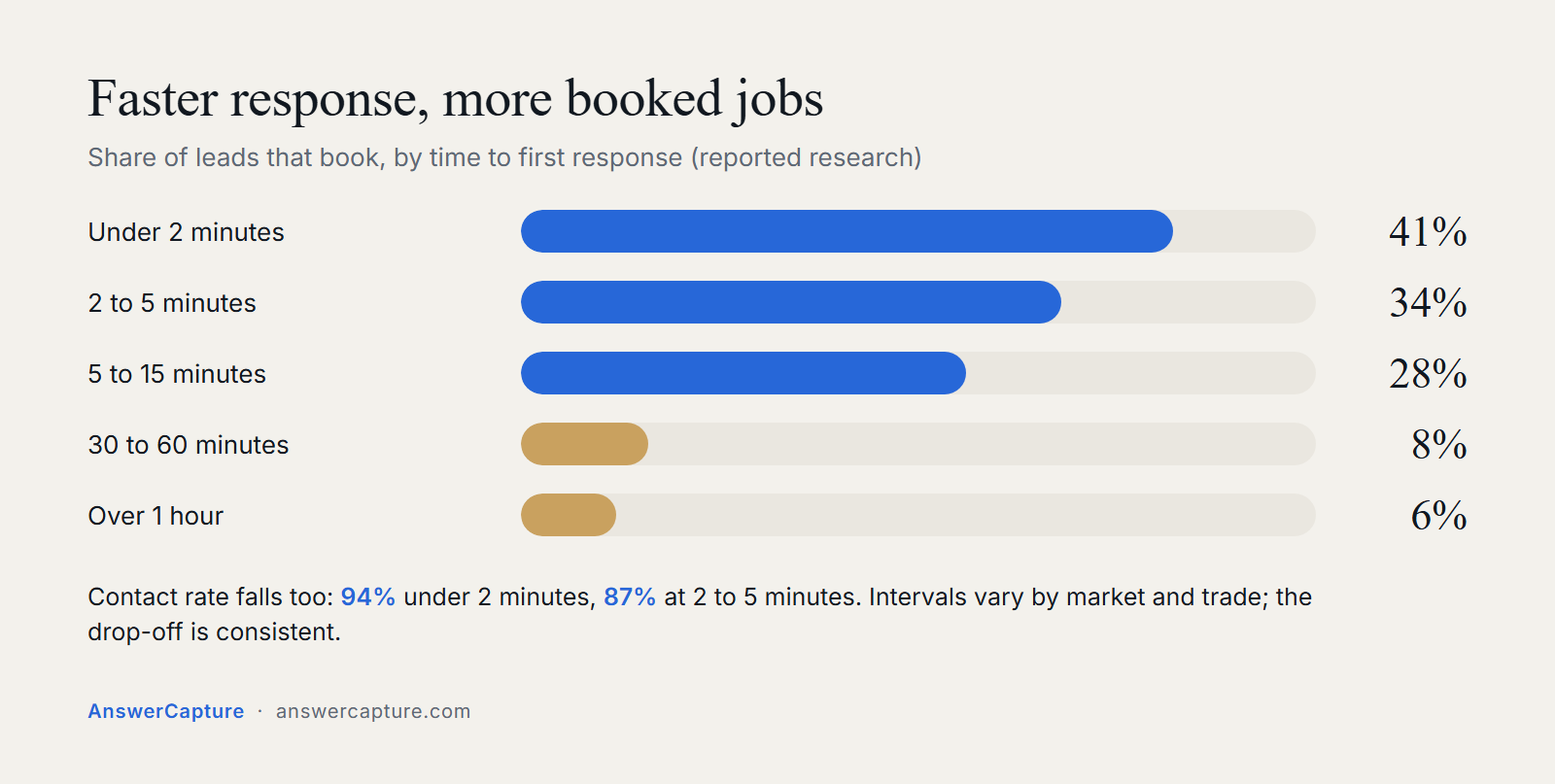
Stretch that window out and watch the numbers fall. At 2 to 5 minutes, the contact rate drops to 87% and booking conversion falls to 34%. At 5 to 15 minutes, the qualification rate slides to 44% and the close rate to 28%. At 30 to 60 minutes, you’re looking at an 18% qualification rate and an 8% close rate. Past the one-hour mark, only 12% of leads qualify and just 6% convert to a booked job. These figures reflect patterns documented across multiple home services lead follow-up studies and CRM platform reports; specific intervals may vary by market and trade, but the directional drop-off is consistent.
The 5-minute mark is the industry-standard floor, not the ceiling. The real competitive edge lives under 60 seconds, specifically in the automated first acknowledgment that confirms receipt and offers a clear next step before any competitor even sees the notification. Most contractors respond in 30 to 90 minutes. The data says they should be responding in under 5. That gap is where revenue disappears.
Where most home service businesses lose the speed game
The operational reasons for slow lead response time are predictable and fixable, but only if you see them clearly. Owners and technicians are in the field when calls come in. Nobody back at the office is monitoring lead intake in real time because there often is no “back at the office.” The call hits voicemail, the form submission arrives in an inbox nobody refreshes during a service call, and the lead evaporates.
Leads from different sources compound the problem. A Google LSA inquiry arrives in one portal. An Angi lead hits a different email address. A website form populates a third system. A missed call sits in voicemail. There’s no unified queue, so notifications fall through the cracks and duplicate handling wastes time. The result isn’t one missed lead; it’s a structural leak across every channel.
Many traditional answering services don’t solve this problem either. A live receptionist can answer a call, but they typically can’t book an appointment, prioritize a high-value emergency, or log the interaction into a CRM. The handoff from the receptionist to the field owner still introduces delay, and after-hours coverage from these services is often inconsistent. The homeowner gets a friendly voice but no confirmed appointment, which means the lead is still in play for a competitor to close.
How to achieve speed to lead for home services: a workflow under 5 minutes
Sub-5-minute first contact requires a specific sequence executed automatically, without depending on a human to initiate each step. Here’s how that workflow runs from inbound signal to booked job.
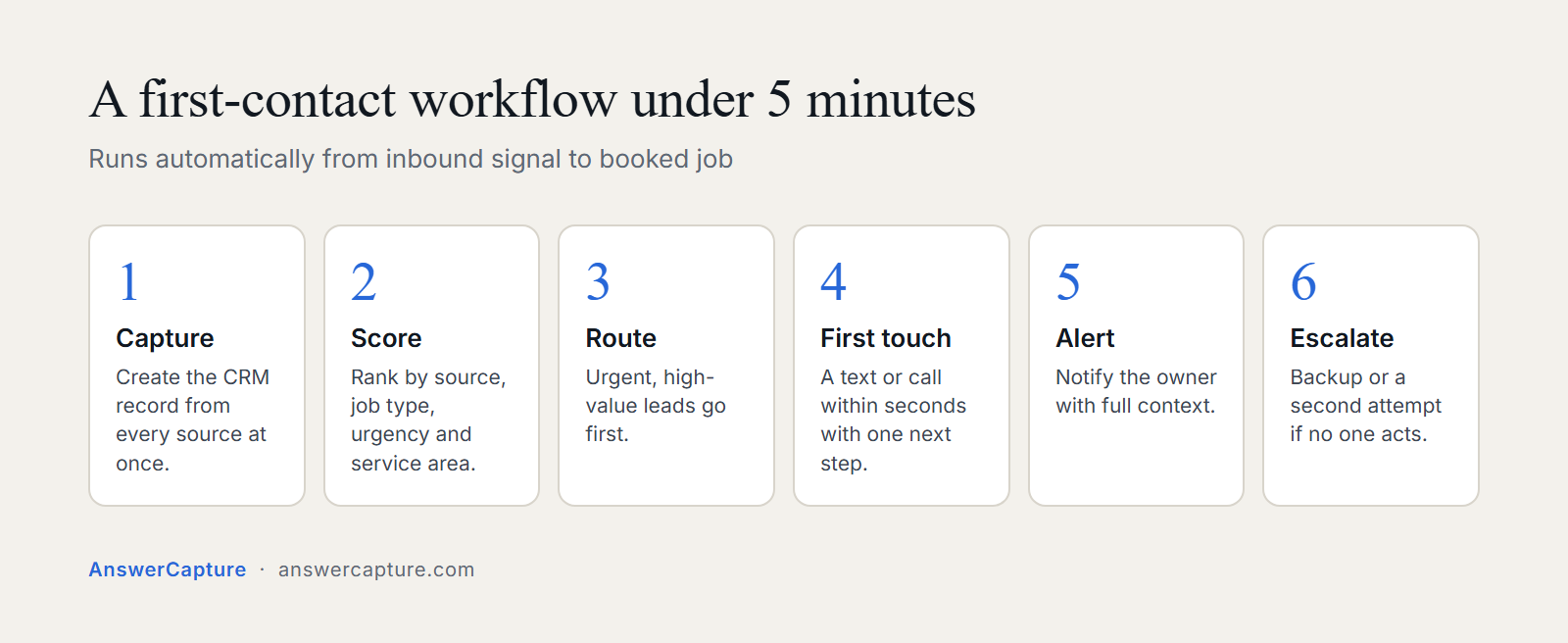
- Capture the lead and create the CRM record immediately, triggered simultaneously from every source: website forms, missed calls, LSA, Angi, Thumbtack, and text inquiries. No manual copy-pasting.
- Enrich and score the lead automatically based on source, job type, urgency signals, and service area. The system decides lead priority before any human touches it.
- Apply routing logic in real time so high-value or urgent leads are handled first and routed to the right person or automation path.
- Fire an automated first touch within seconds: a text or call acknowledgment that confirms receipt and offers a single next step.
- Alert the business owner or next available handler with full context and a one-tap action path so they’re not hunting through multiple systems.
- Escalate if no human action happens within the defined window, routing to a backup or triggering a second automated attempt.
This is exactly the infrastructure AnswerCapture builds for home service businesses. As a company claim: the system is designed to sit between an inbound lead and a booked job, handling prioritization, routing, CRM logging, and real-time appointment scheduling automatically, 24 hours a day. The business owner doesn’t manage the system. The system manages the lead from first touch to booked job. That’s the operational model that makes near-instant lead response achievable for a two-person plumbing company or a 12-tech HVAC operation.
Other platforms that pull from Google LSA, Angi, Thumbtack, website forms, and missed calls into a unified queue include LeadTruffle, Avoca AI, and Hatch. Whichever tool you evaluate, the non-negotiable capability to look for is automatic first-touch triggering without requiring a human to initiate it, plus CRM logging and calendar booking integration built in. AnswerCapture’s advantage is that the full infrastructure, routing logic, escalation paths, and booking integration, is configured and managed for you rather than handed over as a platform to figure out on your own.
First-contact scripts that move homeowners to a yes
The best SMS first contacts are 1 to 3 sentences, personalized with the homeowner’s name and the specific service they requested, and end with a single clear action. Not a list of questions. Not a long company introduction. One next step. That structure works because it signals competence immediately, you know who they are, you know what they need, and you’re already moving.
For an immediate acknowledgment, try: “Hi [Name], this is [Your Name] with [Company]. Got your request about [Service]. Do you prefer a quick call or text to set up the next step?” For an appointment-oriented opener: “Hi [Name], I’m [Your Name] with [Company]. I have time on [Day] at [Time] or [Time] to talk through [Service]. Which works better?”
On a phone call, keep the opener under 30 seconds: confirm the inquiry, tell them you’re reviewing the details, then ask one question about next steps. On email, use a short subject line that references the specific service, two sentences confirming receipt, and one reply path or scheduling option. No long introduction, no sales pitch on the first touch. The pattern that works across all three channels is identical: personalize to the specific request, confirm you’re already on it, and offer a single next step.
What faster home services lead follow-up actually does to your revenue
A typical speed-to-lead automation setup costs $250 to $800 per month, with managed infrastructure solutions running higher. Setup costs typically range from $500 to $2,500. Those numbers sound significant until you put them next to what the return side looks like.
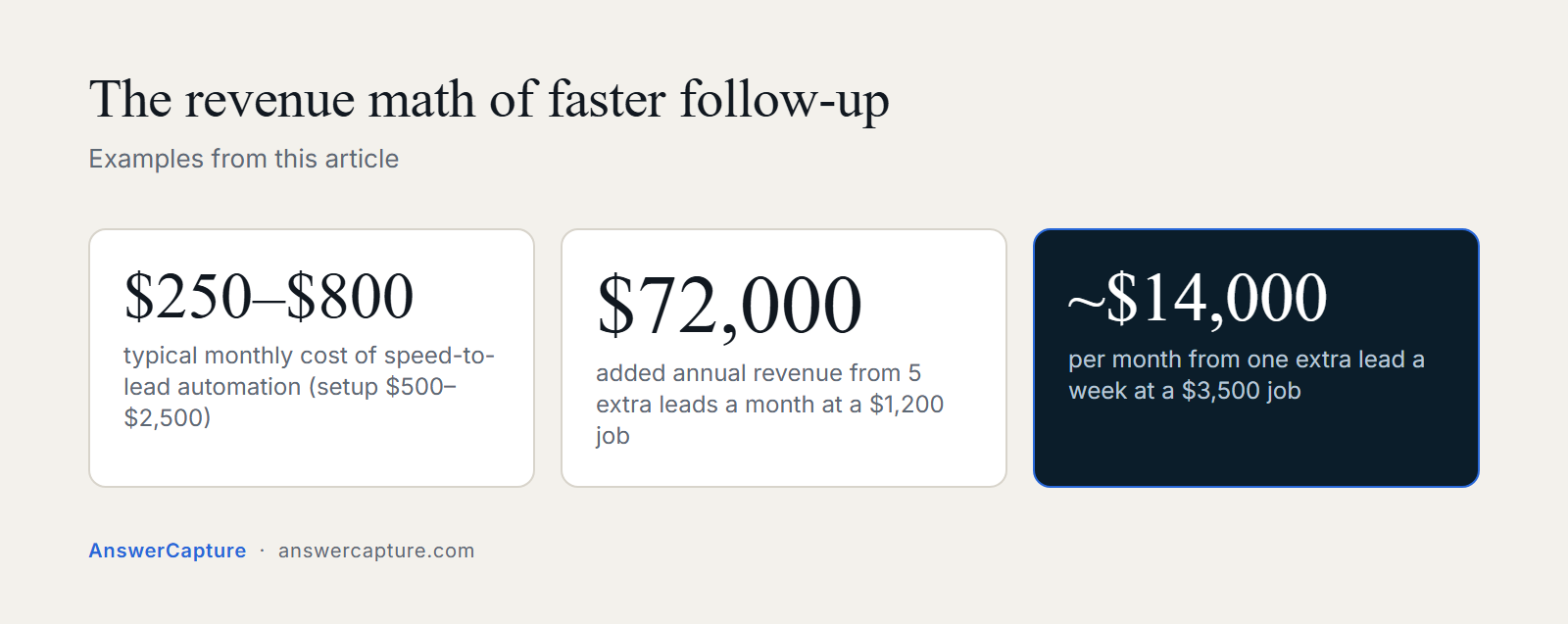
The practical math is direct: converting five additional leads per month at a $1,200 average job value adds $72,000 in annual revenue. If your average job is $3,500 and you capture one extra lead per week, that works out to roughly $14,000 per month (using a four-week approximation) or about $182,000 annualized. ROI figures reported by home-service businesses using automation vary widely based on volume and market, but the investment justifies itself with a fraction of that lift in most cases.
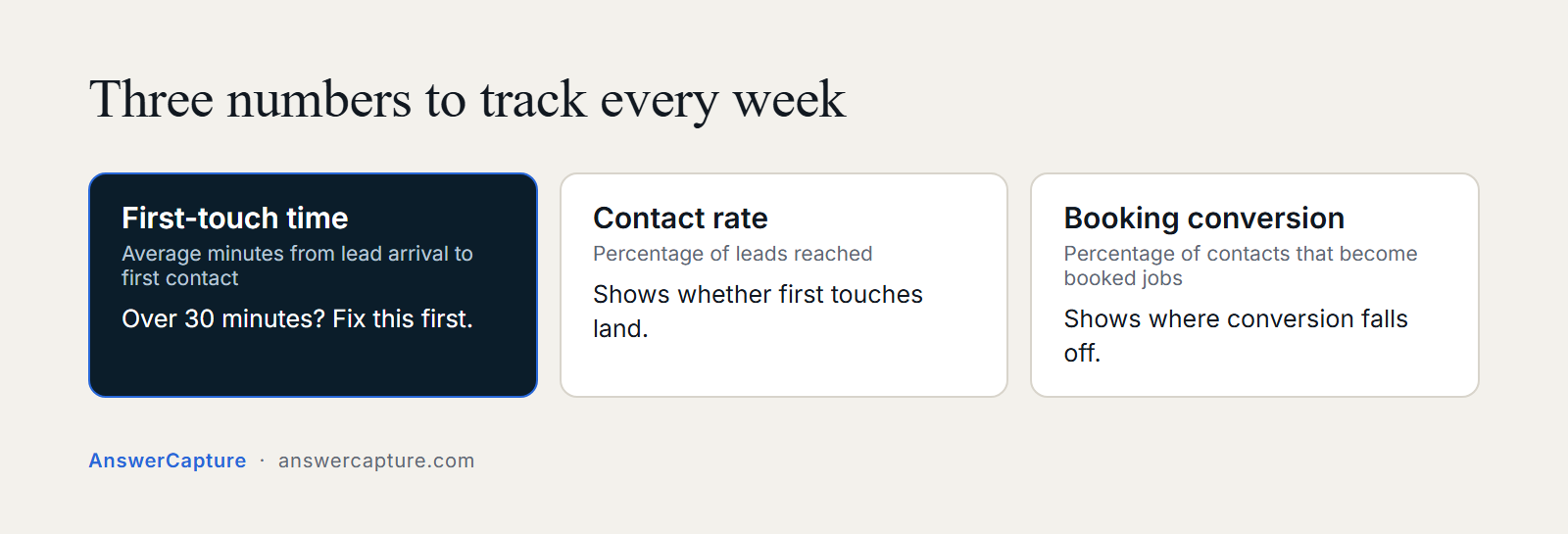
To measure whether your system is actually working, track three numbers every week: first-touch time (average minutes from lead arrival to first contact), contact rate (percentage of leads reached), and booking conversion (percentage of contacts that become booked jobs). If your first-touch time is averaging more than 30 minutes, that’s the only number that matters until it drops below 5. Everything else is secondary. Review results monthly and adjust routing, channel mix, and automation triggers based on where your conversion is falling off.
The contractors winning right now respond first, every time
Quick lead follow-up for home services isn’t a competitive advantage anymore. It’s table stakes. The contractors winning in 2026 aren’t necessarily running better ads or charging less. They’re the ones who respond first, consistently, because they’ve built a system that makes it automatic.
The homeowner who submits that form at 6:45 PM on a Friday doesn’t care about your years in business or your five-star average. She cares who answers. The contractor who confirms an appointment before the other two have even seen the notification wins the job, the review, and likely the repeat business.
AnswerCapture exists to be that infrastructure for home service businesses that can’t afford to miss another inbound lead. The system handles answering, prioritization, CRM logging, and real-time booking automatically, whether the team is on a job, asleep, or swamped during peak season. If your business is still relying on manual follow-up to convert inbound demand, improve your speed to lead for home services, reach out to our team and see what a done-for-you system actually looks like in action.
Hear it handle a call in the live demo.