
You’re on a job site when your phone rings. You can’t answer. The caller hears voicemail, hangs up, and dials the next contractor they found on Google. By the time you check your messages two hours later, that job is gone, and the caller is already booked with someone else. This isn’t a customer service failure, it’s a lead response automation failure, and it happens dozens of times a week in service businesses across the country.
The fix isn’t hiring a receptionist or checking your phone more often. It’s building a system that closes the gap between an inbound lead and a booked job without requiring you to be available every minute of the day. Done well, lead response automation captures the call, acknowledges the contact, routes the inquiry intelligently, and locks in the booking before your competitor’s phone even rings. This article covers why response speed determines conversion, what that automation looks like in practice, and how to stop losing revenue during your busiest periods.
What the data says about speed to lead
The 5-minute benchmark most service businesses don’t know about
The research on response time is not subtle. Contacting a lead within the first minute produces an 85% contact rate. Within 1 to 5 minutes, that rate holds at 72%. These aren’t marginal differences worth debating, they’re the difference between consistently booking jobs and consistently losing them to whoever picks up faster.
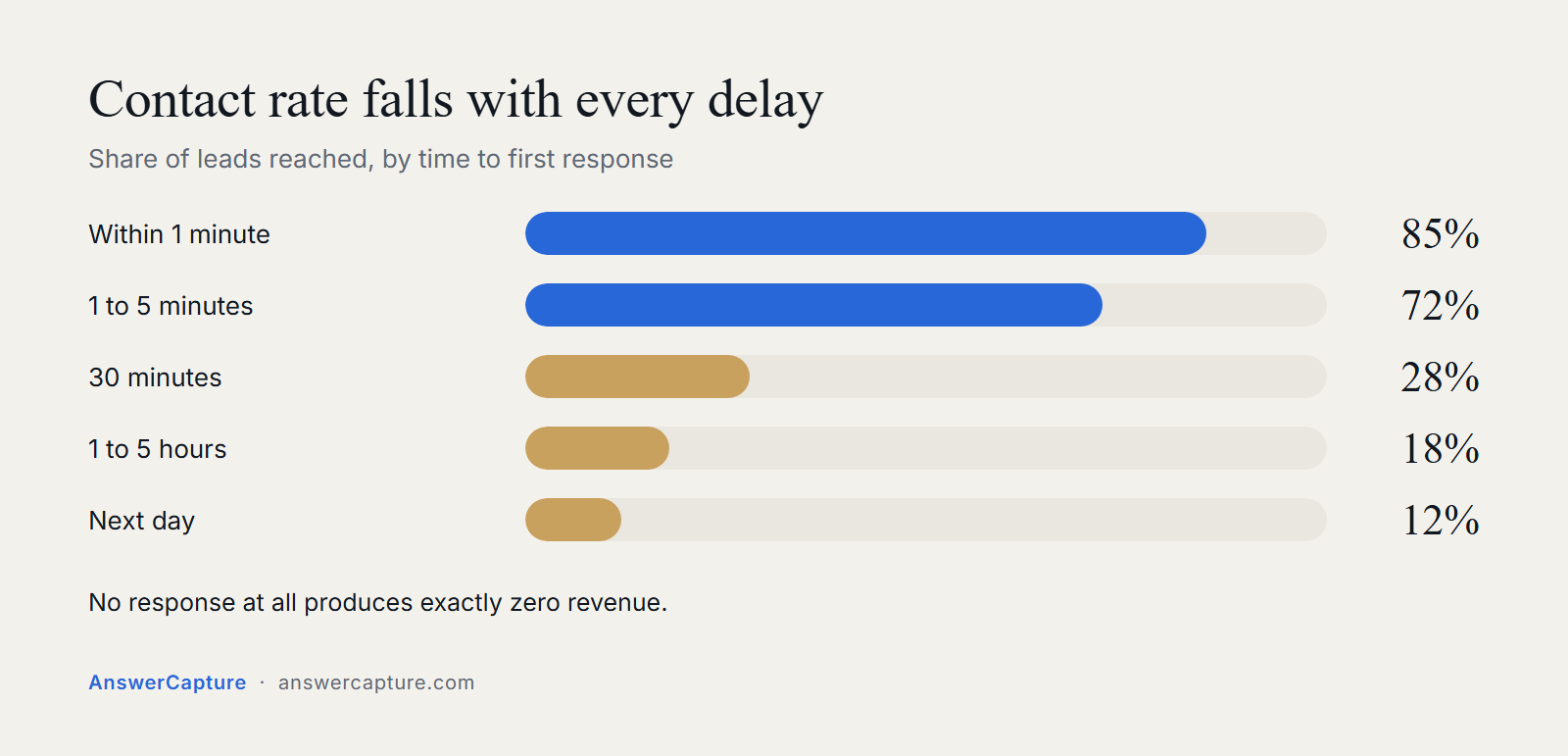
After 5 minutes, the numbers collapse. At 30 minutes, contact rates fall to 28%. At the 1-to-5 hour mark, they drop to 18%. By the next day, you’re looking at a 12% contact rate and around 4% conversion. No response at all produces exactly zero revenue. Every minute of delay is a statistical loss, not a theoretical one.
Where most service businesses actually fall
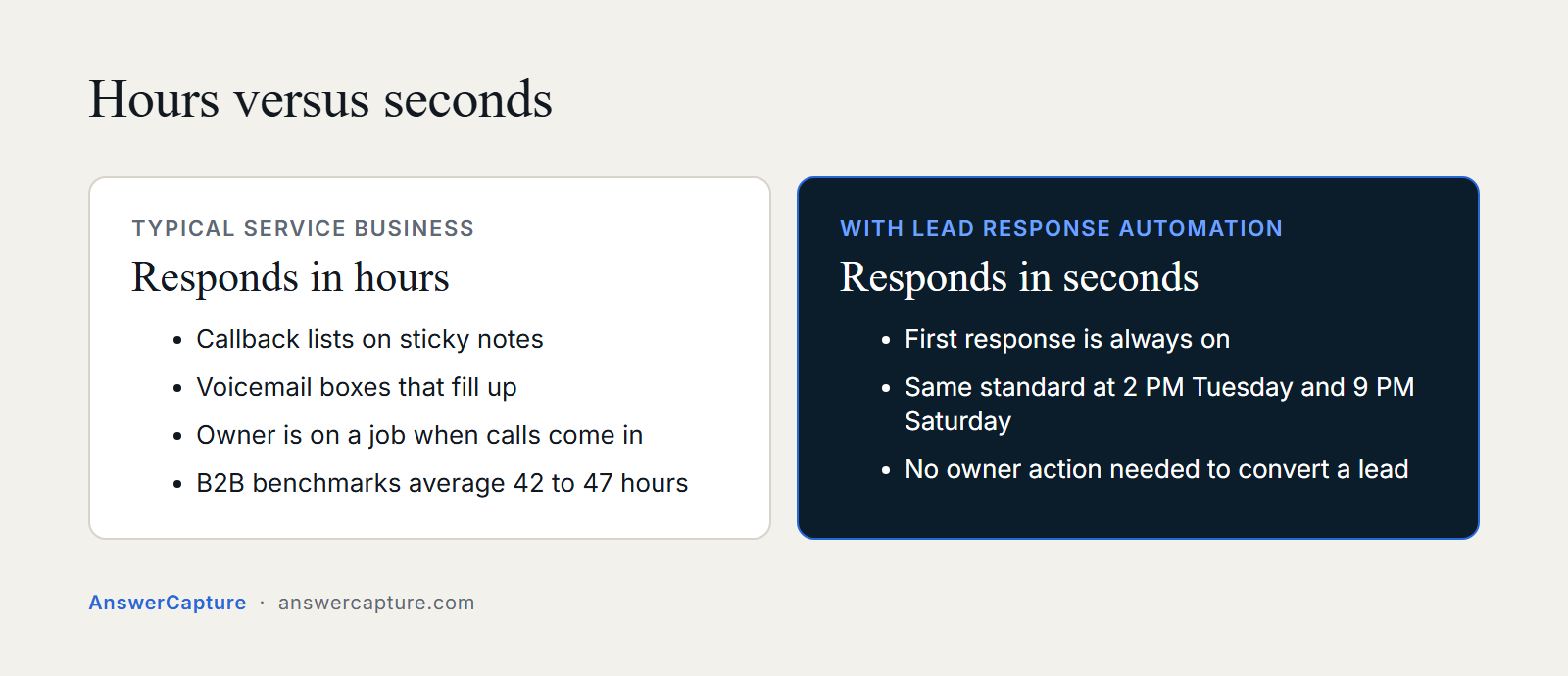
The painful reality is that most service businesses aren’t responding in minutes, they’re responding in hours, if at all. Industry benchmarks on B2B response times have found averages in the range of 42 to 47 hours. Even service companies that try to be responsive often operate with callback lists written on sticky notes, voicemail boxes that fill up, and owners who are physically on jobs when calls come in. The average service business is responding in hours. The average competitor who uses automation is responding in seconds. That gap is where revenue disappears.
What lead response automation actually means
The difference between automation, management, and nurturing
These three terms get used interchangeably, and that confusion causes real problems when service business owners try to build the right system. Lead response automation is the mechanism: the instant acknowledgment, the routing decision, the automated lead follow-up until a human steps in. Lead response management is the broader system for tracking how leads are handled over time and improving that process consistently. Automated lead nurturing is the long game, ongoing communication for prospects who aren’t ready to convert yet.
Automation is what fires immediately when a call comes in. Management is what ensures your whole inbound process runs well. Nurturing is what keeps a prospect warm over weeks or months. For a service business, the most urgent problem to solve is almost always automation: the instant response gap between a lead contacting you and your system capturing them.
Why this looks different for phone-driven businesses
Most lead response software is built around web forms, email inquiries, and CRM workflows. That architecture makes sense for SaaS companies and digital agencies. For a plumbing company, an HVAC contractor, or a roofing business, the inbound call is the lead. Any system that starts its automation after the call is missed is already too late. Capturing the call, not the form submission, is the actual problem to solve.
Most service business owners don’t have a sales team running a CRM. They have the owner, maybe one office admin, and a phone. Automation fills the gap that would otherwise require a full-time hire. For phone-driven businesses, effective lead response automation means capturing the call, routing it intelligently, and booking the job in real time without any manual intervention.
How slow follow-up costs service businesses revenue during peak demand
The peak-season problem no basic answering service fully solves
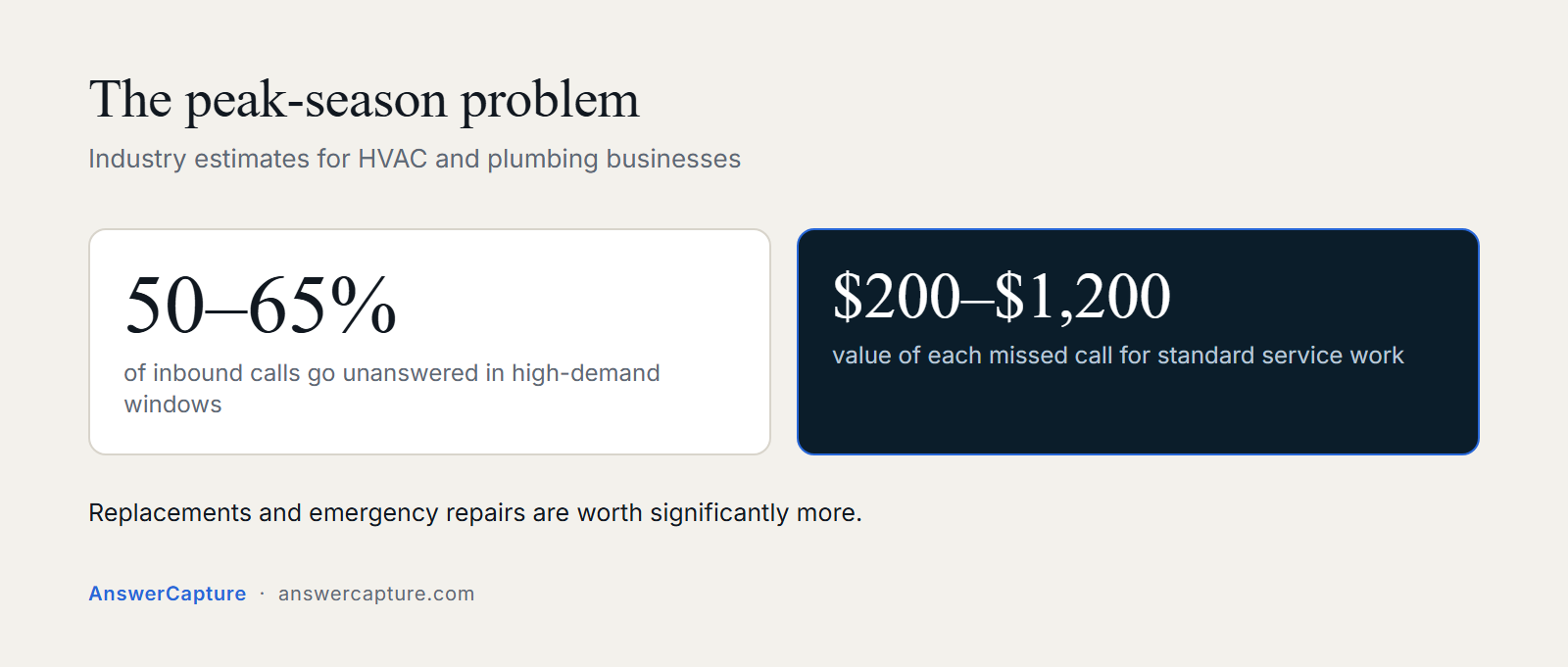
During an HVAC summer surge, a winter heating emergency, or a roofing season spike, call volume increases exactly when the owner is least available. The owner is in the field. The office admin is overwhelmed. Calls stack up, and the ones that don’t get answered immediately often don’t get answered at all. Industry estimates suggest that 50% to 65% of inbound calls go unanswered for HVAC and plumbing businesses during high-demand windows. Each of those missed calls represents a job worth $200 to $1,200 for standard service work, and significantly more for system replacements or emergency repairs.
The gap between calls received and jobs actually booked widens exactly when it matters most. The demand is already there, already generated by advertising spend that’s already been paid for. The only question is whether your infrastructure can convert it. If it can’t, you’re effectively funding your competitor’s growth every time a lead calls and hits your voicemail.
Why traditional solutions leave money on the table
Voicemail creates friction and delay. Live receptionist services can take a message but rarely book the job on the spot, and they’re not available around the clock at a price small service businesses can sustain. Callback reminder systems depend on someone being available to make the callback quickly, which eliminates the advantage entirely. These aren’t effort problems, they’re architecture problems. The tools themselves aren’t designed to capture and book a lead in real time without a human on standby.
What service businesses need is a system that operates identically at 2:00 PM on a Tuesday and 9:00 PM on a Saturday. AnswerCapture builds to that standard: an always-on infrastructure layer that sits between the inbound call and the booked job, handling capture, routing, and scheduling in real time so the owner never has to be available to convert a lead.
Lead response automation workflows: from first contact to booked job
End to end, without manual steps
A fully automated lead response workflow for a service business moves through a clear sequence. When a call comes in, the system answers instantly, captures the caller’s intent and key details, and acknowledges the contact. The inquiry is then routed based on urgency and type, emergency calls get prioritized, routine service requests follow standard booking logic. A real-time booking fires the appointment directly onto the owner’s calendar, and a CRM record is created automatically with the call summary, caller details, and job type. No voicemail, no callback list, no delayed follow-up. The job is booked before the competitor’s phone rings.
The practical result is that the owner shows up to work each morning with jobs already on the calendar from calls that came in overnight, over the weekend, or during back-to-back field appointments the previous day. The system captures what used to fall through the cracks, not occasionally, but on every call, every day.
What “done-for-you” implementation means in practice
There are two ways to build this kind of system. You can configure it yourself using tools like HubSpot, Pipedrive, or Zoho CRM and handle the integration work, routing logic, and ongoing management on your own. For a small service business without a dedicated operations person, that configuration burden often kills adoption before the system produces a single booked job.
Done-for-you implementation means the routing logic, CRM integration, booking flow, and automated lead follow-up sequences are built and maintained on your behalf. The owner experiences the output: more booked jobs, fewer missed leads, and full visibility into every customer interaction. AnswerCapture’s model works this way by design, because an owner who is already running jobs in the field doesn’t have time to troubleshoot automation workflows at night.
The metrics that tell you your lead response is working
Numbers every service business should track
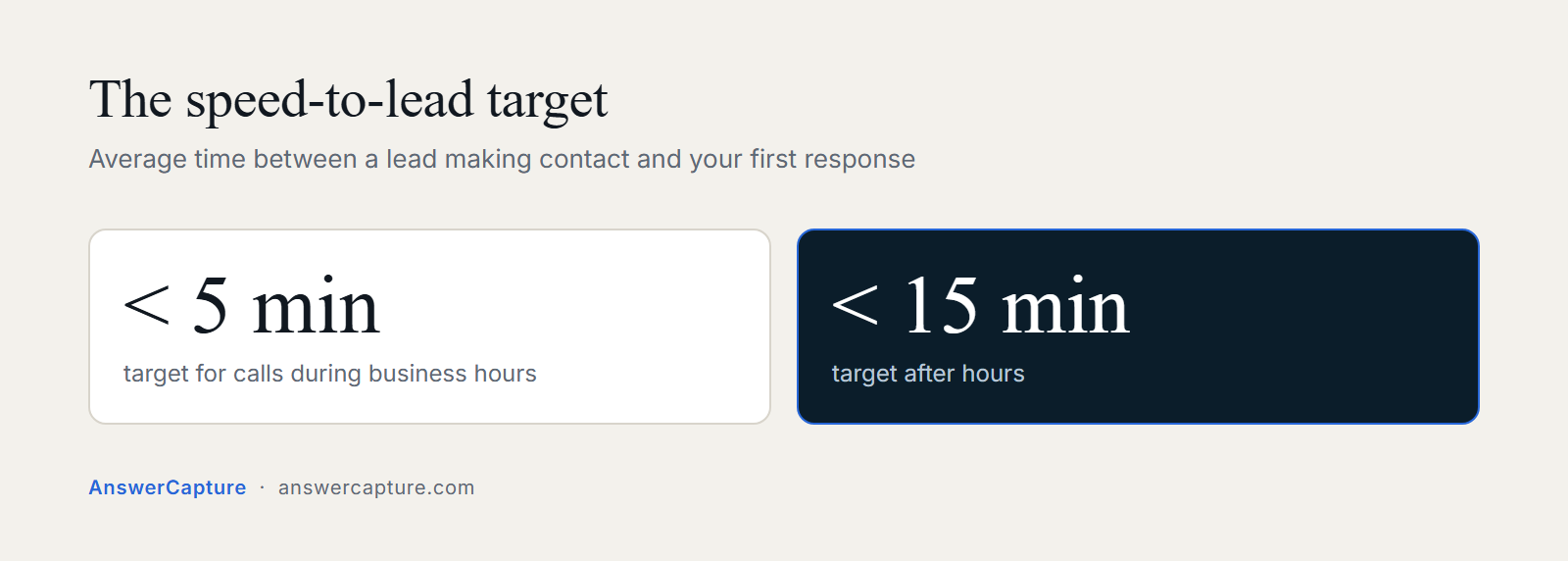
Speed to lead is the average time between a lead making contact and your system’s first response. The target is under 5 minutes for calls during business hours and under 15 minutes after hours.
Contact rate measures the percentage of inbound leads that are actually reached and acknowledged, not just received. This number tells you whether your coverage is real or just theoretical.
Booking conversion rate tracks the percentage of contacted leads that become scheduled jobs. Together, these three numbers tell the full story from inquiry to revenue and reveal exactly where the system is working and where it’s leaking.
A high contact rate with a low booking conversion rate points to a routing or scheduling problem. A low contact rate points to a coverage gap: after-hours calls, weekend volume, or missed demand during peak season. Tracking these numbers without acting on them accomplishes nothing. But when you know which metric is low, you know exactly what to fix.
How to use these metrics to improve over time
Service business owners who measure these metrics consistently close a materially higher percentage of the leads they’re already generating. The automation itself generates the data you need to improve it. Call logs, booking timestamps, contact records, and conversion rates all accumulate automatically in a well-built system. Automation gives you the data to fix the right thing, not just the thing that’s most visible. Without that data, most owners are guessing at whether their call handling is costing them money. With it, the answer is obvious.
Stop leaving revenue on the table
Most service businesses aren’t losing revenue because they don’t have enough leads. They’re losing it because their infrastructure can’t keep up with the leads they already have. The calls are coming in. The demand is real. The advertising has already been paid for. The question is whether your system converts that demand into booked jobs or lets it walk to the next number on the list.
Lead response automation is the answer, not for theoretical future prospects, but for the calls that are already coming in right now and going unanswered during peak hours, busy seasons, and nights you’re not available. Whether you build your own system using CRM tools or implement a done-for-you infrastructure layer, the goal is the same: capture every lead, acknowledge every call, and convert every bookable job before a competitor does.
The businesses that solve this problem first stop competing on price and start competing on availability. If you want to see what a fully automated inbound capture system looks like before you commit, AnswerCapture offers a live call demo so you can experience lead response automation in action. That’s where the conversation starts.