
The phone rings while you’re under a crawl space. You’re loading the van after a job. You’re on another call when the second line lights up. Someone picks up, or it goes to voicemail, and either way the caller has probably booked with someone else by 5 PM. Most service business owners have lived through this more times than they want to count. It’s the exact problem that better answer capture is supposed to solve, and the trouble is that most businesses are misreading where the problem actually lives.
At AnswerCapture, we were built around a specific idea: picking up the phone is only the beginning of the job. The real work happens in the 90 seconds after the call connects. Logging the lead, assessing urgency, routing it to the right workflow, converting that conversation into a confirmed appointment on the calendar. Without all of that, the call was answered but nothing was captured. That gap between answering and capturing is exactly where revenue quietly disappears.
This article breaks down what genuine answer capture actually means for a service business, where the conversion gap lives, and what a complete system looks like when it’s working correctly.
What answer capture actually means for a service business
Across software and data contexts, capturing an answer means preserving and transforming a response so it can be processed, stored, and acted on. The principle applies directly to inbound calls. The customer call is the answer. Capturing it means the call gets logged, the lead gets categorized, and the information gets routed into a workflow that ends in a booked appointment, not just a note on a sticky pad that someone finds Tuesday morning.
Most service business owners define answer capture as simply having someone pick up the phone. That’s presence, not capture. A call that gets answered but results in a vague “we’ll call you back” has not been captured. The lead is still exposed. Genuine answer capture is a complete chain: intake, log, prioritize, route, book. Break any single link and the revenue leaks out at that point.
The distinction matters because it changes where you look for the problem. If you’re only measuring whether calls are being answered, you’re measuring the wrong thing. The real question is how many calls are moving all the way through the chain and ending as confirmed jobs on the schedule.
Answering the phone vs. capturing the call: the distinction that matters
When a call gets answered, the business has cleared only the first hurdle. The caller’s information still needs to go somewhere useful. Their urgency still needs to be assessed. The appointment still needs to land on a calendar. Answering gives you a window of opportunity. Capture is what you do with that window before it closes.
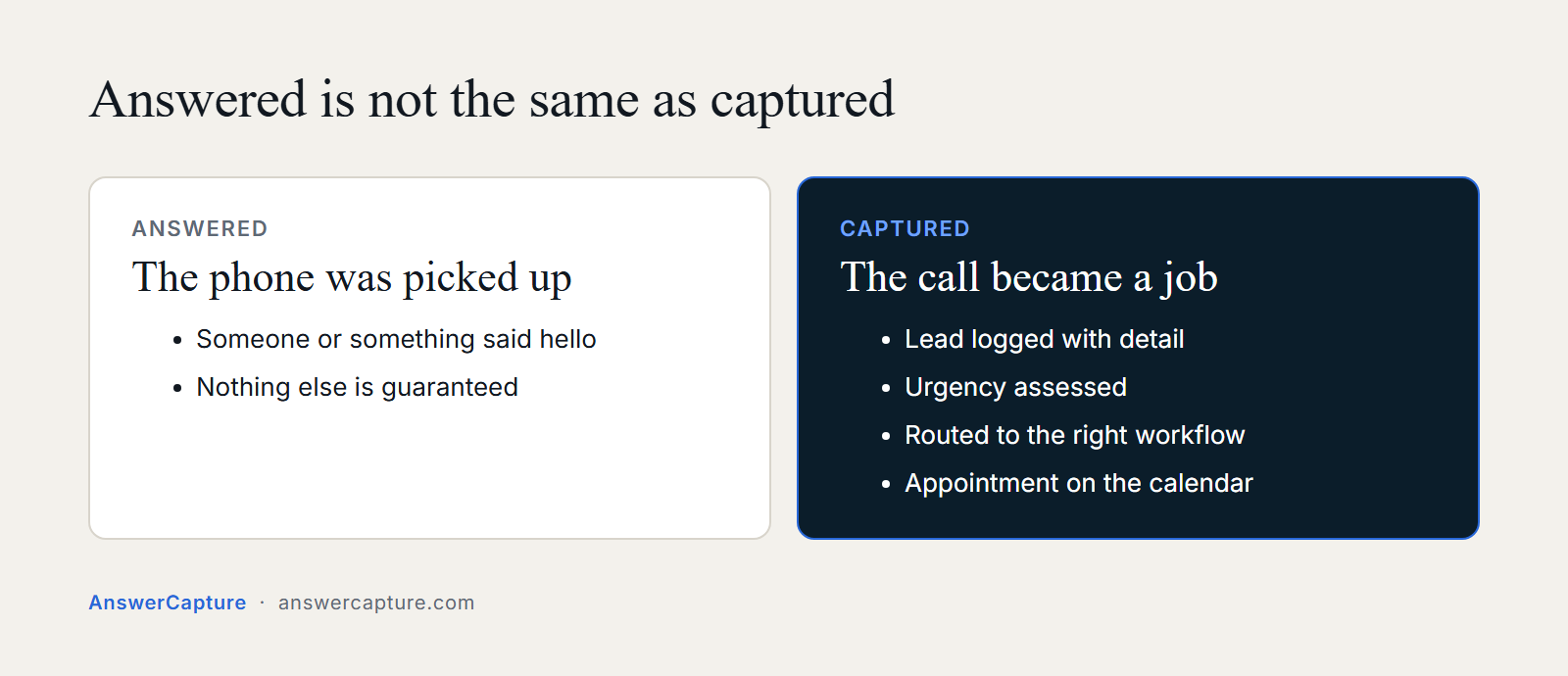
Live receptionist services and basic voicemail solutions typically collect a name and a callback number. That information then waits for a return call that may come hours later, go to voicemail again, or feed into a scheduling system that hasn’t been updated since last week. This is not capture. It’s a holding pattern with a high attrition rate. Callers don’t wait. They open a second browser tab and call the next contractor on the list.
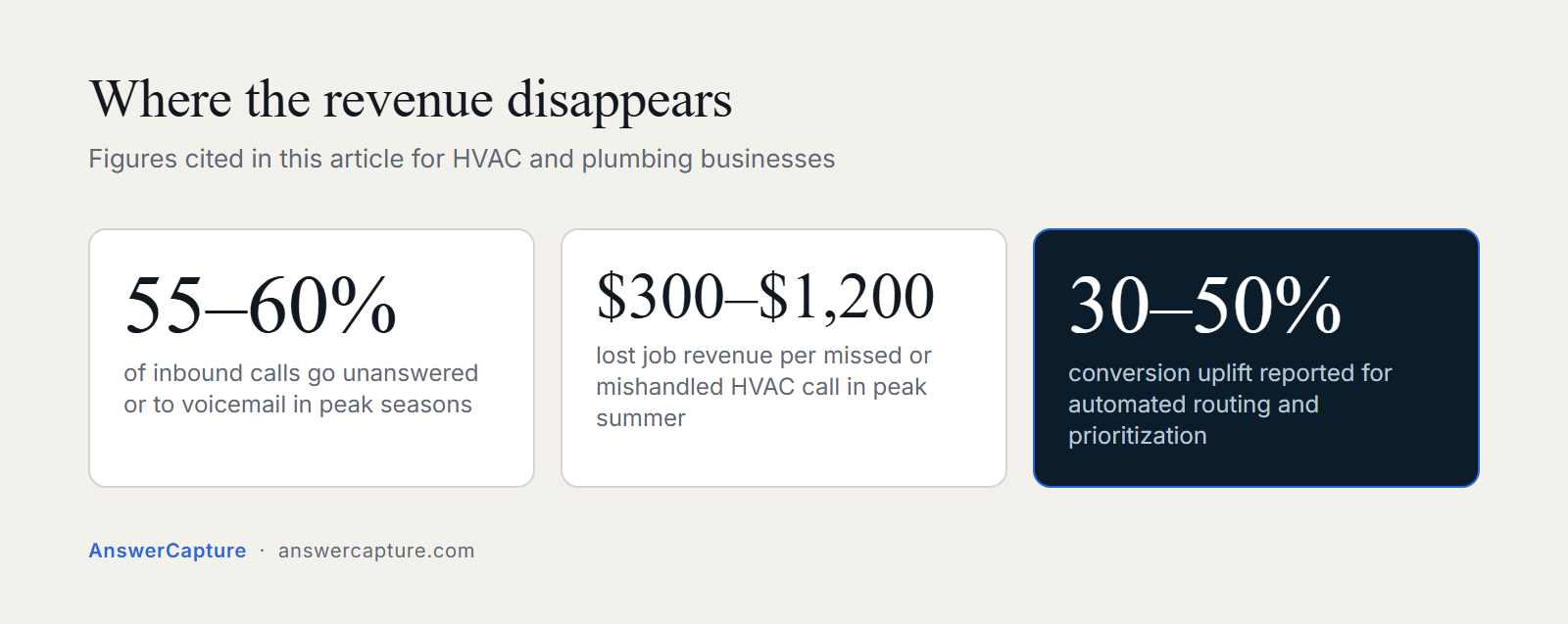
The conversion gap this creates is larger than most owners realize. During peak seasons, studies on HVAC and plumbing businesses consistently find that 55 to 60 percent of inbound calls go unanswered or to voicemail. That means roughly half of all callers, people who already found you and already picked up the phone with intent, never make it to a booked job. Not because your service was worse. Because the answer capture chain was incomplete.
Where revenue disappears between “hello” and a booked job
There are predictable points in every inbound call flow where leads escape the pipeline. The caller gets sent to voicemail during peak hours. A receptionist takes a message but forgets to flag urgency. A callback goes to a number that doesn’t answer. The appointment never makes it to the calendar. Each of these is a capture failure, not an answering failure. The call came in. The revenue did not come through.
The biggest leakage points in home service inbound workflows follow a consistent pattern: unanswered calls, slow response times, and the gap between initial contact and a confirmed booking. Speed-to-lead research shows that callers who don’t hear back within five minutes are significantly more likely to contact a competitor before any follow-up happens. After-hours and peak-hour calls are especially high-risk because that’s when staff coverage is lowest and caller intent is often highest.
The dollar value of each uncaptured call is not abstract. For an HVAC company during peak summer season, a single missed or mishandled call commonly represents $300 to $1,200 in lost job revenue, depending on the service type. Multiply that across a busy Tuesday afternoon when three or four calls slip through and you’re looking at a meaningful, recurring revenue loss that doesn’t show up on any report, because nobody tracked the calls that were never captured.
The mechanics of real-time answer capture
How answer capture software qualifies and routes leads
Real answer capture infrastructure handles the first layer of intake automatically. The call comes in, it gets logged, and the system immediately begins qualifying and routing based on predefined logic. Is this an emergency service call or a standard estimate request? Is this a repeat customer or a new lead? High-priority calls surface immediately. Standard inquiries follow a different path. This happens in real time, without manual sorting by a staff member who may or may not be available.
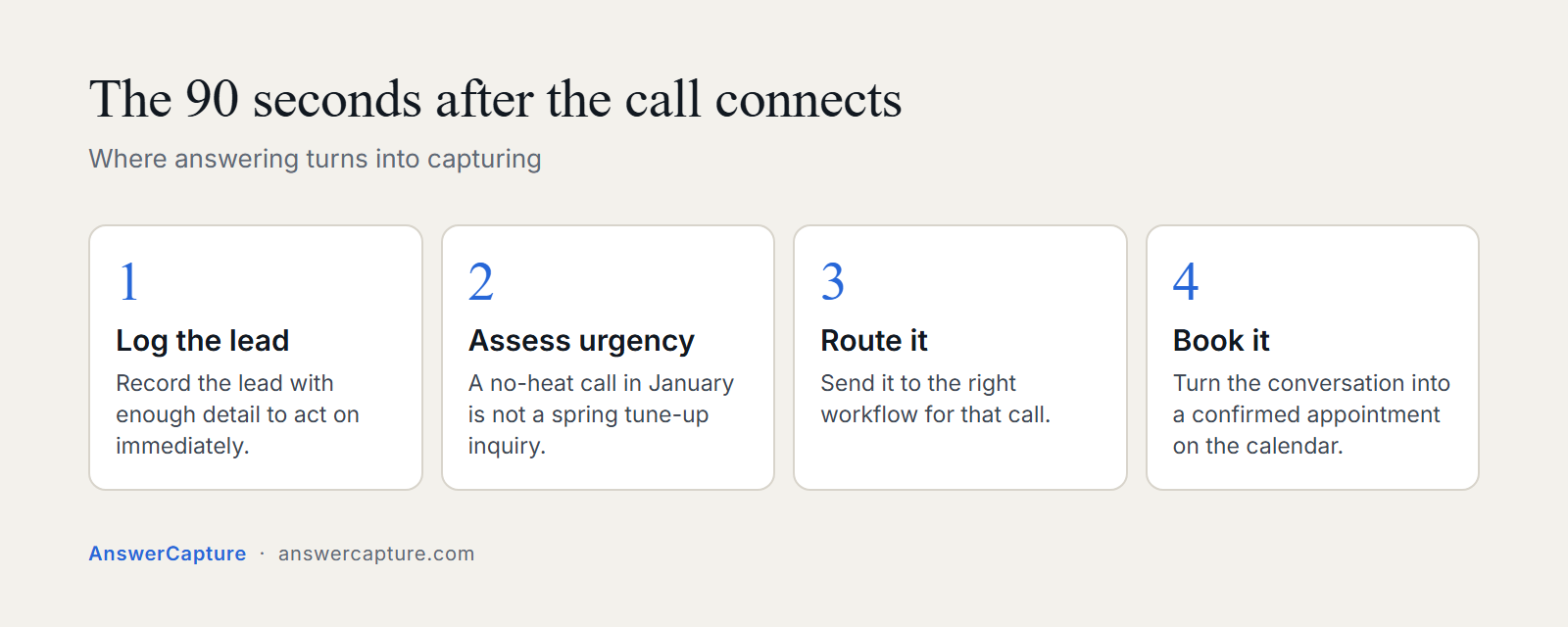
Priority routing is where conversion rates actually shift. Not all calls carry equal urgency or equal value. A no-heat call in January is not the same as a general inquiry about a spring tune-up. True answer capture software applies priority logic that ensures the highest-value and most time-sensitive calls are handled first and handled correctly. Industry analyses of automated routing and prioritization systems report conversion uplifts in the range of 30 to 50 percent when callers are matched to the right workflow based on intent and urgency rather than simply being answered in order.
The final step of genuine capture is scheduling. The appointment lands on the calendar in real time, no callbacks required, no manual data entry afterward. When this step happens automatically, conversion rates improve because there’s no window for the lead to cool off or reconsider. The job is booked before the caller hangs up. That’s the close of the chain, and it’s the step that most traditional answering solutions never reach.
AnswerCapture’s infrastructure: built for the full capture chain
AnswerCapture was designed around zero-failure communication principles drawn from emergency services operations, not call center volume metrics. Calls are not just answered. They are triaged. Priority is assigned. Routes are set. Booking is confirmed. The infrastructure doesn’t wait for a human to make those decisions manually after the fact.
Most call handling tools require configuration, ongoing management, and monitoring by the business owner or someone on their team. AnswerCapture’s approach is the opposite. The infrastructure is implemented and operated without placing technical burden on the owner. Every call gets logged, every interaction gets summarized via CRM logging, and every lead gets routed. The owner sees the results without running the operation. That’s the difference between buying software and having infrastructure.
Where a live receptionist service stops at taking a message, AnswerCapture’s system continues through CRM logging, priority routing, and calendar booking in a single connected workflow. The system operates around the clock, including after hours, weekends, and peak demand periods, exactly when the highest-value calls come in and when capture failures are most common for businesses relying on manual coverage.
What a complete answer capture system should actually deliver
A genuine answer capture system clears five bars consistently:
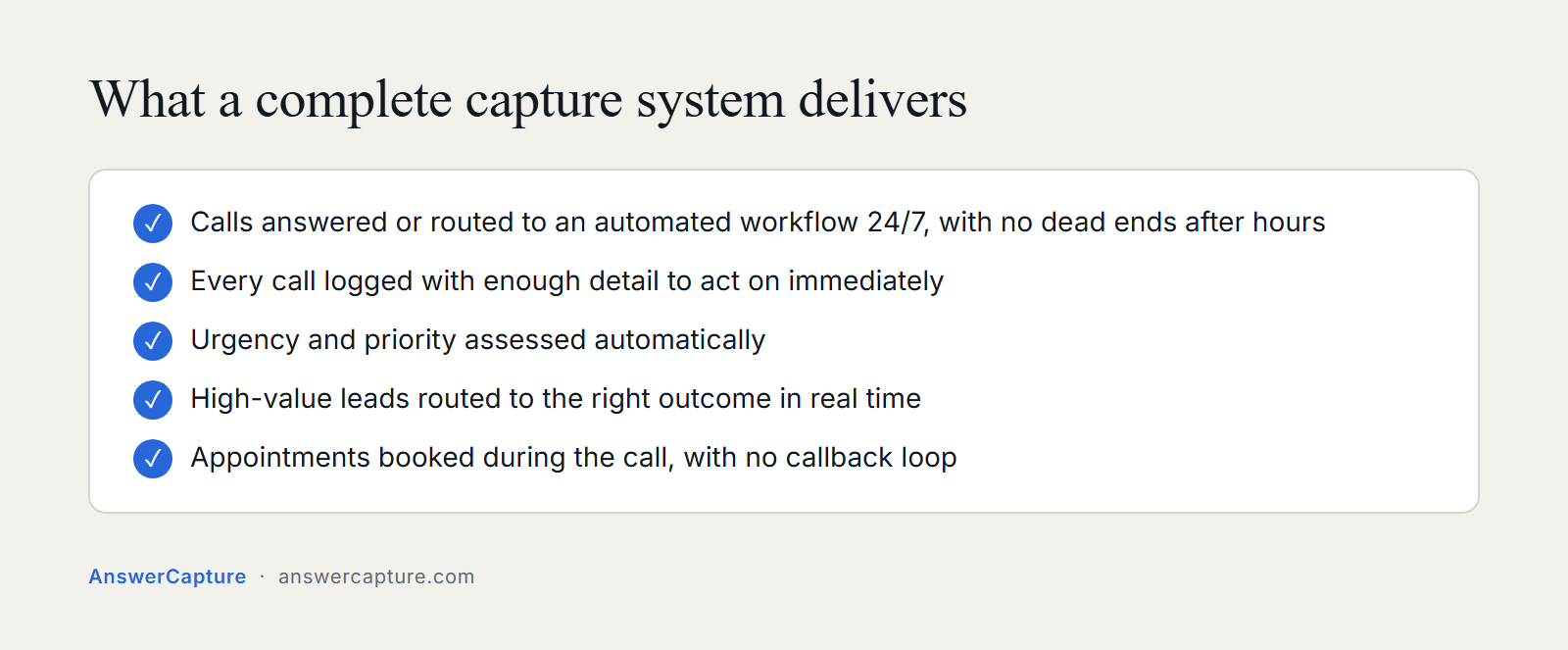
- Calls are answered or routed to an automated workflow 24/7, with no dead ends for after-hours callers
- Every call gets logged with enough detail to act on immediately, no gaps from manual entry done hours later
- Urgency and priority are assessed automatically without manual sorting
- High-value leads are routed to the right outcome in real time
- Appointments are booked during the call without requiring a callback loop
If any of these steps relies on manual effort or falls away after business hours, the system is incomplete. You have coverage. You don’t have capture.
Coverage and capture are not the same thing. Coverage means someone can answer. Capture means every call that comes in becomes a recoverable data point moving through a defined workflow toward a booked job. Service businesses that have only coverage are still leaving revenue on the table every day, often without realizing it, because the lost calls simply don’t appear in any report.
The goal is full capture: every call, every hour, every season, converted into a job on the schedule before the caller’s intent fades. That’s the standard AnswerCapture was built to meet, and it’s the standard every inbound call system should be held to.
The gap is real, and it closes with the right infrastructure
Answer capture isn’t about picking up the phone. It’s about what happens in the seconds after, the logging, the routing, the prioritization, the booking that turns a caller into a confirmed appointment. Most service businesses operate with coverage but not capture, and that gap is where revenue disappears without showing up on any report.
AnswerCapture exists to close that gap with done-for-you infrastructure that handles the entire capture chain in real time. Callbacks don’t sit in a queue. Manual entry doesn’t happen hours after the call. Leads don’t cool off on a message pad overnight. Every inbound call becomes a tracked, prioritized, and bookable event before the caller moves on.
If you want to hear what that sounds like in practice, request a live call demo. You’ll experience the full system before committing to anything, and you’ll see exactly where your current call flow is leaving revenue uncaptured.