If you’ve ever asked yourself, “How do I convert more inbound calls into booked HVAC jobs?”, the answer starts before anyone picks up the phone. The average U.S. residential HVAC company books roughly 42% of its answered calls and closer to 25–30% of all inbound calls once missed ones are counted, according to inbound-call-to-booking benchmarks. Top performers book 62–70% of answered calls. That gap is not a marketing problem; it is a systems problem. Poor call handling can quietly cost a company a large share of its peak-season revenue, yet it is almost entirely preventable. This guide walks through every stage where calls fail to convert, what to say and do at each one, and how to build a repeatable phone-to-booking process that gets more reliable as your team internalizes it.
Many owners believe conversion problems start during the call. They rarely do. The failure usually happens before anyone picks up, or the moment the call goes unanswered at 9 PM on a Tuesday. Fix the structure first, then the script.
Key takeaways
- True conversion math: Multiply your answer rate by your booking rate among answered calls to find your real inbound-to-booking percentage. Most companies land around 29%.
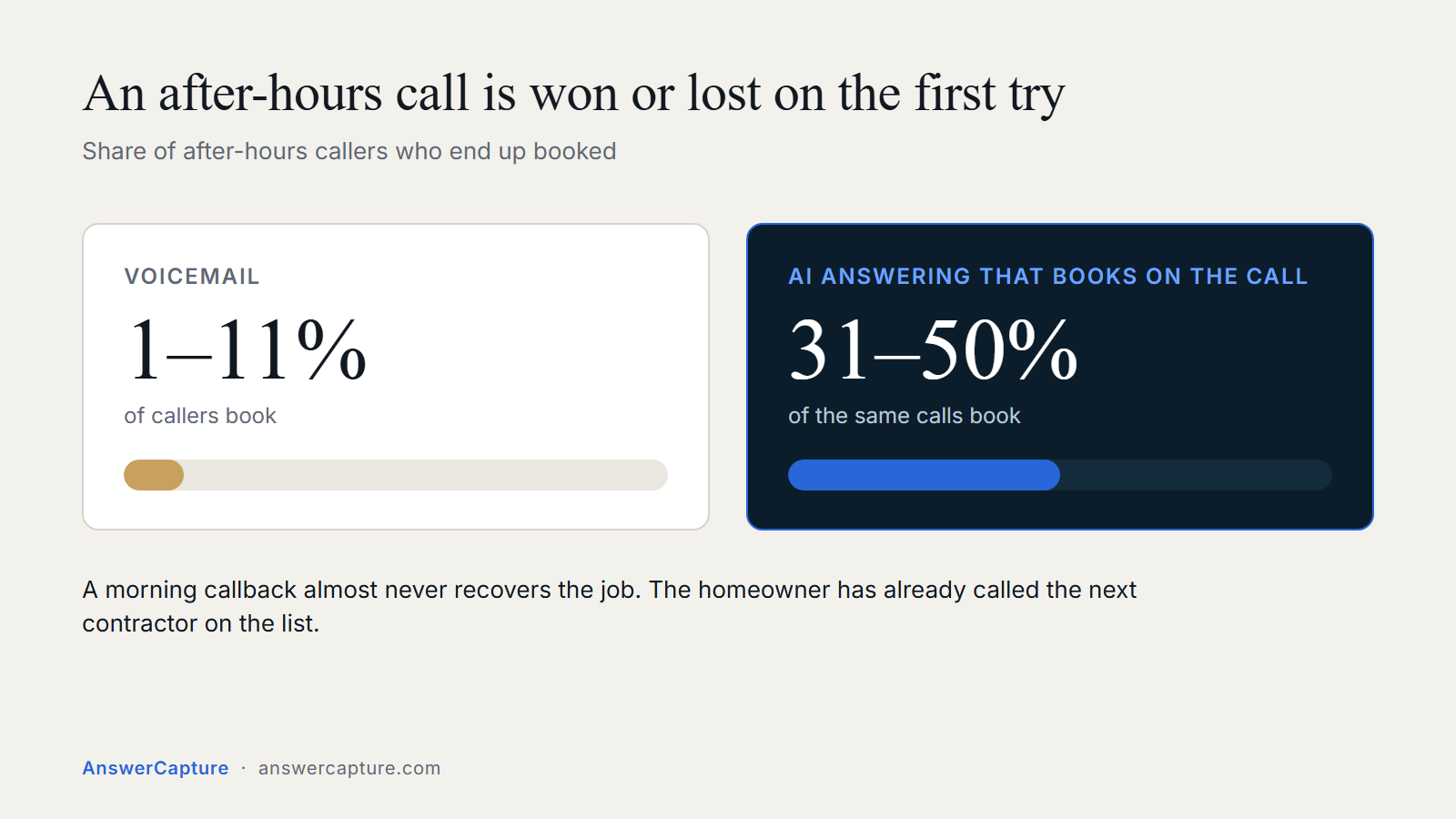
- Missed calls are hard to recover: After-hours callers who hit voicemail book at 1–11%; AI answering converts 31–50% of the same calls by booking during the original call.
- Scripts reduce variance: A structured open, qualifying questions, and a two-option close produce consistent bookings regardless of who answers the phone.
- Objections are unresolved questions: Acknowledge, clarify with one question, then confirm a specific next step rather than leaving the call open-ended.
- Book before they hang up: Any process that requires a callback to confirm loses a meaningful percentage of bookings before the technician is ever dispatched.
- Four KPIs reveal everything: Answer rate, booking rate among answered calls, cancellation rate, and revenue per inbound call tell you exactly where the system is breaking down.
Why most HVAC calls fail to convert before the booking conversation starts
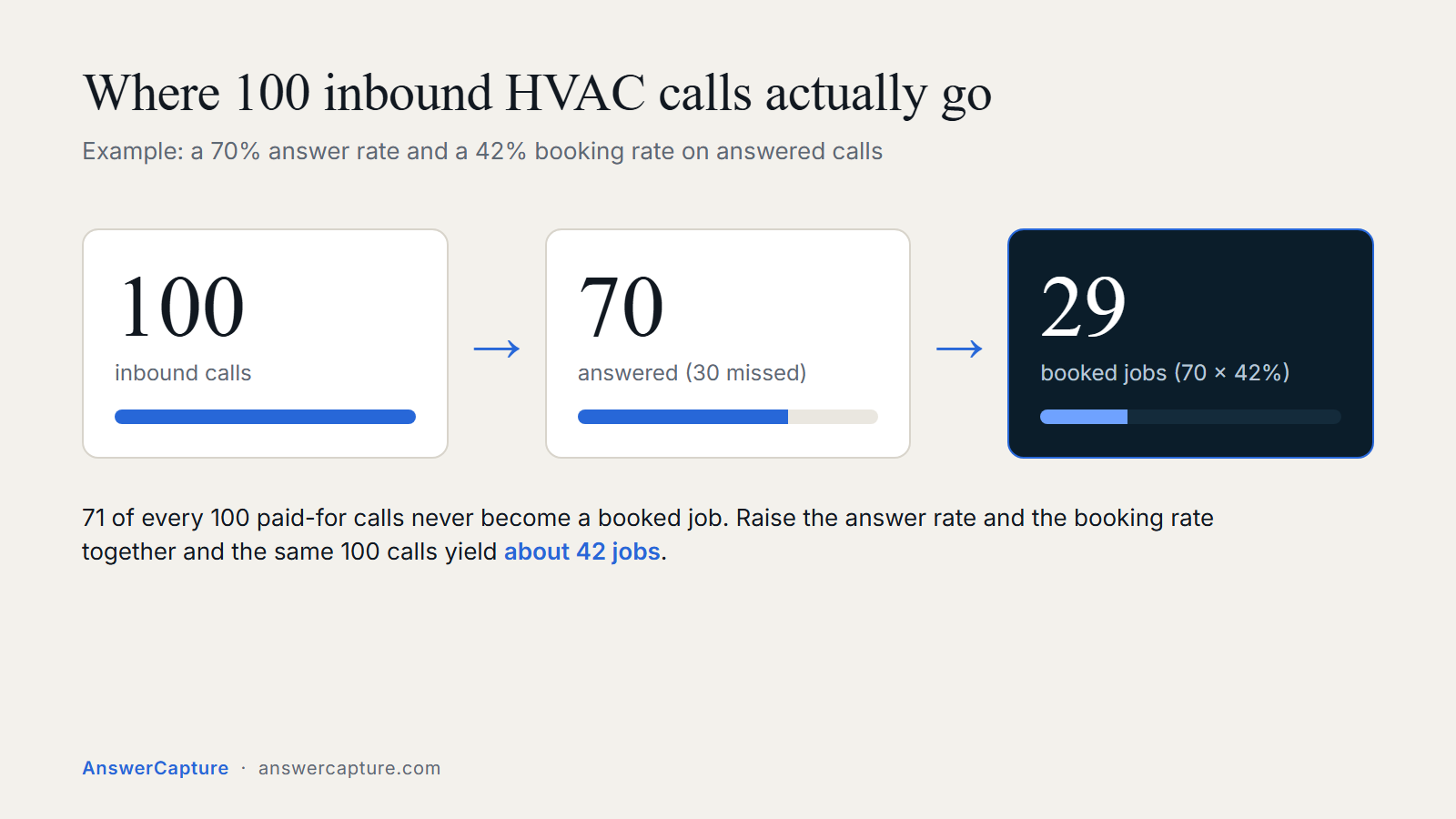
Structural breakdowns kill conversions upstream, before any script or tactic can help. Many HVAC companies pay a significant cost per inbound lead through paid search, then answer only around 68% of those calls, a revenue leak that opens before a single word is spoken. At a 42% booking rate among answered calls, the effective inbound-to-booking conversion sits around 29%. For every 100 leads generated, 71 do not become booked jobs. That math is brutal regardless of the ad spend that produced the calls.
After-hours voicemail is where the most expensive calls die. When an emergency call hits voicemail at 9 PM, many homeowners simply call the next contractor on the list. That is simply what callers do, the next name gets the job. Callback attempts the following morning almost never recover the job. The homeowner either booked with someone else or decided the system was functioning well enough to wait for a scheduled appointment from a company that actually answered. Voicemail converts roughly 1–11% of after-hours callers into booked customers, compared to 31–50% for AI answering systems that qualify and book during the original call.
Undertrained staff and inconsistent call handling compound the problem. Whoever answers the phone is your conversion rate. A field technician fielding calls from a job site while covered in refrigerant will lose bookings that a structured process would close. A CSR who asks “What day works for you?” instead of offering two specific windows adds unnecessary friction to a decision that should take thirty seconds. The call itself is where the process either works or fails, and many HVAC companies have never written that process down.
How do I convert more inbound calls into booked HVAC jobs? Start with your baseline numbers.
Before optimizing anything, calculate your true inbound-to-booking rate. The formula has two parts: your answer rate (answered calls divided by total inbound calls), multiplied by your booking rate among answered calls (booked jobs divided by answered calls). A 70% answer rate combined with a 42% booking rate yields a true conversion of about 29%. That number is your diagnostic baseline, and it tells you immediately whether you have an answer-rate problem, a booking-rate problem, or both.
The benchmarks that separate average from top-performing HVAC companies are clear. Average operations book roughly 42% of answered calls, with the true all-inbound rate closer to 25–30%. Top performers convert 62–70% of answered calls. If your booking rate among answered calls is below 42%, the call process needs rebuilding. If you are above 55%, you are in optimization territory, not reconstruction mode, though treat that figure as a practical rule of thumb rather than a hard industry threshold. Pull these numbers from your call log, CRM, or phone system dashboard, and calculate them monthly so changes in either variable surface immediately.
Call structure that converts inbound HVAC calls into booked jobs
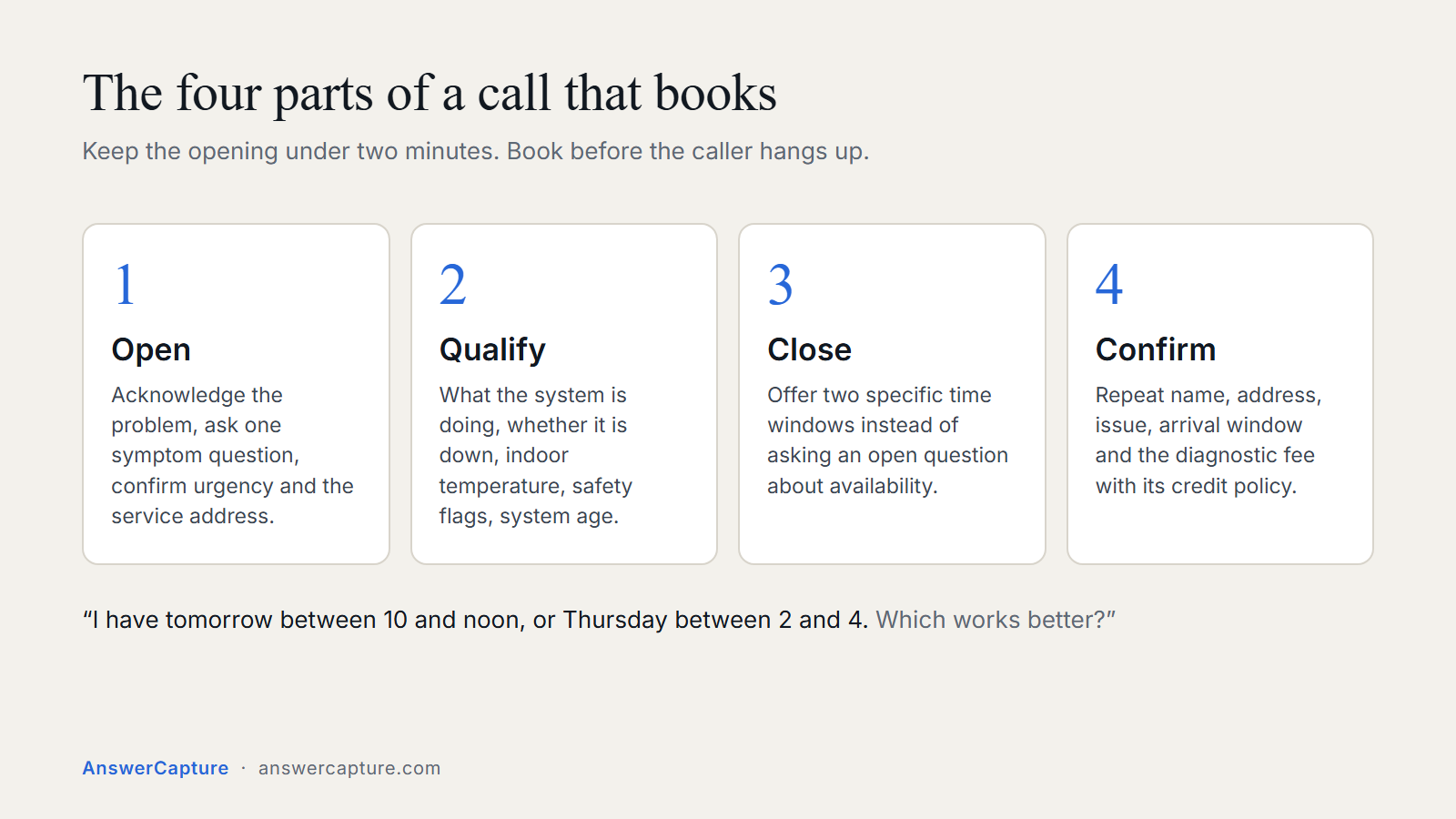
The opening of a call sets the conversion trajectory. Acknowledge the problem, ask one focused symptom question, determine urgency, and confirm the service address.
Opening
That initial sequence should take under two minutes. Keep it tight and purposeful, callers with an HVAC emergency do not want small talk.
Qualifying
The qualifying questions that matter most are:
- What the system is doing, in the caller’s own words
- Whether the system is completely down or still running
- The current indoor temperature
- When the issue began
- Whether there are any safety flags like gas odor or burning smell
- The system’s approximate age
These questions help determine routing and urgency, not just job fit. A caller reporting an indoor temperature of 94 degrees with an infant in the home gets a different response than a caller asking about a noise the unit started making last week.
Close
The close should never be an open-ended question about availability. Offer two specific time slots and let the caller choose between them: “I have tomorrow between 10 and noon, or Thursday between 2 and 4. Which works better?” This assumptive two-option close removes the yes/no decision entirely and keeps the conversation moving toward a confirmed appointment. Specific windows also signal operational professionalism. A company that says “we can be there Tuesday morning or Thursday afternoon” communicates reliability before a technician sets foot in the home.
Confirmation
The confirmation recap prevents no-shows and sets expectations before arrival. Repeat the customer’s name, the service address, the reported issue, the arrival window, and the diagnostic fee with the credit policy stated clearly. “The diagnostic fee is $X, credited toward the repair if approved, and the technician will review all options before any additional work is performed.” That sentence answers the three questions callers silently ask: what will this cost me upfront, will I be surprised later, and do I control the decision? A strong confirmation converts a booked appointment into a kept one.
How to handle the objections that stall bookings mid-call
The diagnostic fee triggers the most friction on inbound HVAC calls, and the right response is not a defense. Frame it as a defined service: “It’s $X, credited toward the repair if approved, and the technician will diagnose the system and review repair options before doing any additional work.” Do not apologize for the fee or offer to waive it before the caller even arrives. Realistic repair ranges stated on the call, combined with the “price approved before work starts” assurance, filter low-intent callers without suppressing qualified bookings.
The three most common delay objections are “I’ll call back,” “I need to talk to my spouse,” and “I’m getting other quotes.” For each one, the effective response follows the same structure: acknowledge, ask one clarifying question, and confirm a specific next step. “I understand. What part would you like to think through, the investment or the options?” surfaces the real concern. “What questions do you expect your spouse will have? We can go through those now” keeps the conversation moving without pressure. Treat every objection as an unresolved question rather than a rejection, and you will close a meaningful percentage of calls that would otherwise end with “I’ll call you back.”
Scheduling and workflow: what happens after the call ends
Whoever takes the inbound call needs live access to the technician calendar. Booking on a callback, or promising to “call back with a confirmation,” loses a measurable percentage of jobs before they are ever dispatched. The practical requirement is a scheduling platform that shows real technician availability during the call, so the CSR can confirm a window in real time. ServiceTitan, Housecall Pro, and Jobber all support this workflow. The key requirement across any platform is two-way synchronization: the scheduling interface must display live technician availability during the call, and a confirmed booking must immediately sync to the customer record, calendar, and confirmation message.
| Platform | Best for | Real-time booking | AI call integration | CRM logging |
|---|---|---|---|---|
| ServiceTitan | Growing dispatch operations | Yes, with Schedule Assistant | Via phone platform integrations | Native |
| Housecall Pro | Small HVAC contractors | Yes | CSR AI built in | Native |
| Jobber | Budget-conscious contractors | Yes | Via Zapier or AI receptionist | Native |
| Goodcall | AI-first after-hours coverage | Yes, during original call | Core function | Via CRM and API |
| AnswerCapture | Done-for-you full infrastructure | Yes, 24/7 including after-hours | Built-in, no setup required | Full call logging and summaries |
After-hours and peak-season volume expose the structural gap between calls received and jobs actually booked. For owners who do not want to rebuild the phone process from scratch or hire additional staff to cover nights and weekends, done-for-you systems like AnswerCapture handle the full call-to-booking workflow automatically. AnswerCapture sits between the inbound call and the booked job: answering around the clock, routing by urgency, booking directly into the calendar, and logging every interaction in the CRM, without requiring the owner to manage, train, or monitor the system. For an HVAC company running peak-season volume during summer cooling calls or winter heating emergencies, that infrastructure layer is the difference between capturing a job and watching a competitor book it at 10 PM.
The four KPIs that tell you if your booking system is actually working
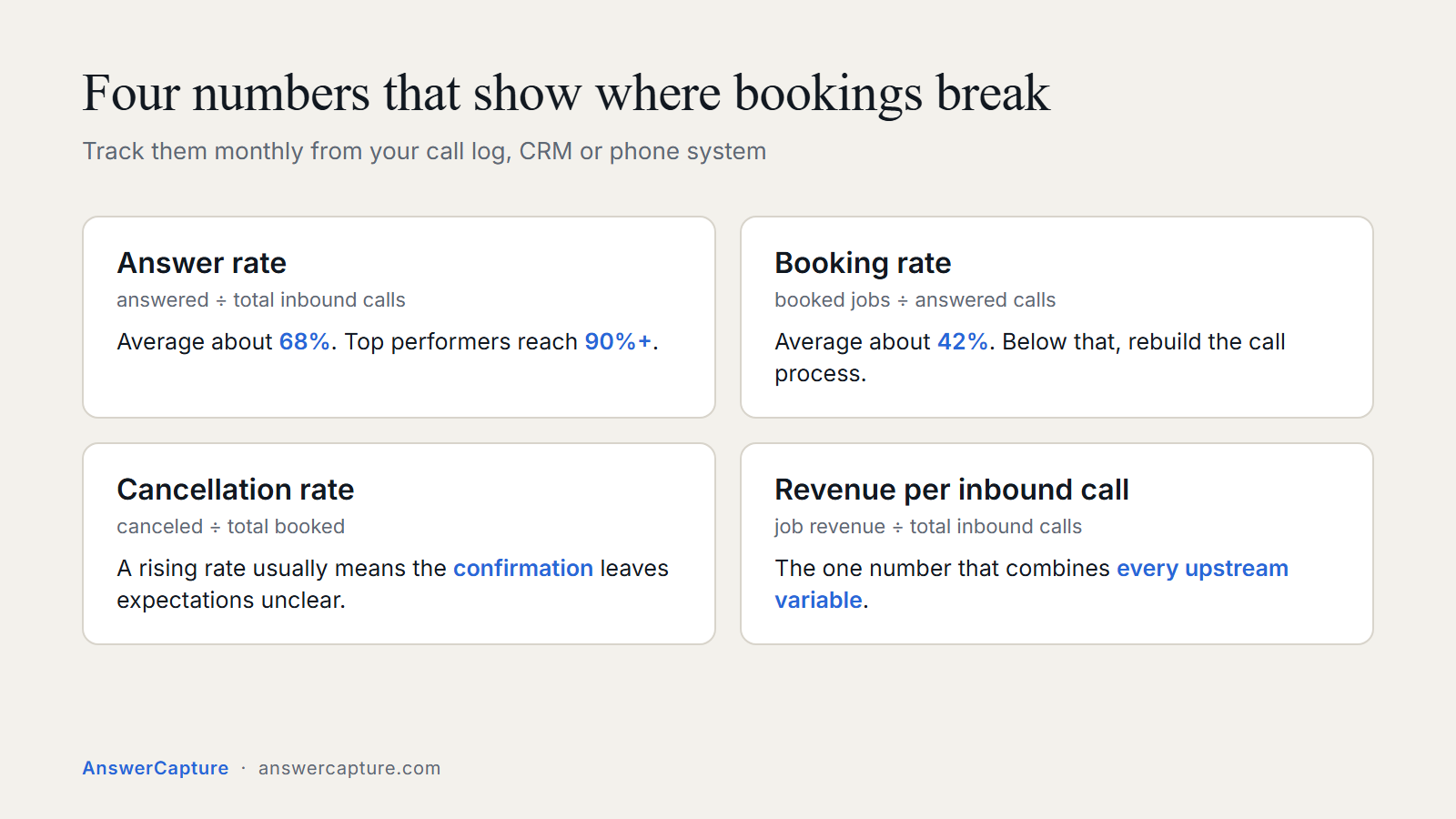
Four numbers reveal the health of your call-to-booking system. Answer rate is calls answered divided by total inbound calls; the industry average sits around 68%, with top performers reaching 90% or better, if your rate falls well below that range, you have an infrastructure gap. Booking rate among answered calls is booked jobs divided by answered calls; below 42% means the call process needs work. Cancellation rate is appointments canceled before service divided by total booked; if your cancellation rate is climbing, the confirmation script is likely leaving expectations unclear. Revenue per inbound call is total job revenue divided by total inbound calls; this is the single number that combines every upstream variable into one metric you can track over time.
Running simple A/B tests on your appointment booking script does not require disrupting operations. Test one variable at a time: the diagnostic fee amount, whether the fee is credited toward repairs, the appointment window length (two hours versus a half-day block), or the phrasing of the opening script. Track results over a minimum of 30 calls per variation before drawing any conclusions, treat that as a small-sample heuristic rather than a statistically rigorous rule, and expand the sample size if results are close. Connect KPI movement back to specific script or process changes so you see the system as a whole. A drop in cancellation rate after tightening the confirmation script tells you more than a manager noting that calls seemed to go better this week. The measurement layer is what turns tactics into a repeatable, improving process.
Putting the system together
Converting more inbound HVAC calls into booked jobs is not about closing harder. It is about removing the friction that exists at every stage of the call, before it is answered, during the conversation, and in the confirmation that follows. Answer the call. Qualify efficiently. Close with two specific options. Handle objections by clarifying the real concern. Book before the caller hangs up. Then measure the four KPIs every month so improvements are tracked rather than assumed.
Each piece of this system reinforces the others. Raising your answer rate and your booking rate among answered calls simultaneously produces a compounding effect on total booked jobs. As a simplified example: a company answering 70% of calls and booking 42% of those lands at roughly 29 booked jobs per 100 inbound calls. Improve both rates by 10 percentage points, to 80% and 52% respectively, and that same 100 calls produces about 42 booked jobs, a roughly 45% increase in output from the same ad spend. For owners already generating inbound demand, that math represents pure revenue recovery, not new marketing investment. The revenue is already calling. The only variable is whether your process picks it up.
That is exactly how you convert more inbound calls into booked HVAC jobs: answer consistently, qualify quickly, close with options, and measure what moves. For owners who want this infrastructure running without building it internally, the AnswerCapture team can walk you through a live demo of the process. You will hear how the system handles a real inbound call, routes by urgency, and books directly to the calendar.
Frequently Asked Questions
Will AI answering help me convert after-hours HVAC calls into booked jobs?
Yes, AI answering can significantly improve after-hours conversion by booking during the original call; voicemail converts roughly 1–11% of after-hours callers while AI answering converts about 31–50% of the same calls. Using an AI-first after-hours solution or a 24/7 done-for-you system that qualifies and books during the call captures jobs that would otherwise be lost to voicemail and competitor callbacks.
Can I realistically recover jobs that hit voicemail overnight with a morning callback?
No, callbacks the following morning almost never recover the job because homeowners often call the next contractor on the list or decide the issue can wait for a company that answered the phone. The better approach is to prevent the voicemail in the first place by raising answer rates or using AI or done-for-you after-hours coverage that books during the original call.
Which scheduling platforms support real-time booking during an inbound call?
ServiceTitan, Housecall Pro, Jobber, Goodcall, and AnswerCapture support real-time booking during the call with varying integration methods and features. ServiceTitan and Housecall Pro have built-in real-time booking and AI integrations, Jobber supports real-time booking via Zapier or an AI receptionist, Goodcall offers AI-first after-hours coverage that books during the original call, and AnswerCapture provides 24/7 real-time booking with built-in call logging and summaries.
How long should the initial opening of an inbound HVAC call take?
The opening should take under two minutes and remain tight and purposeful so callers with an HVAC emergency are not subjected to small talk. A quick acknowledgment, one focused symptom question, urgency determination, and address confirmation set the conversion trajectory without wasting the caller’s time.